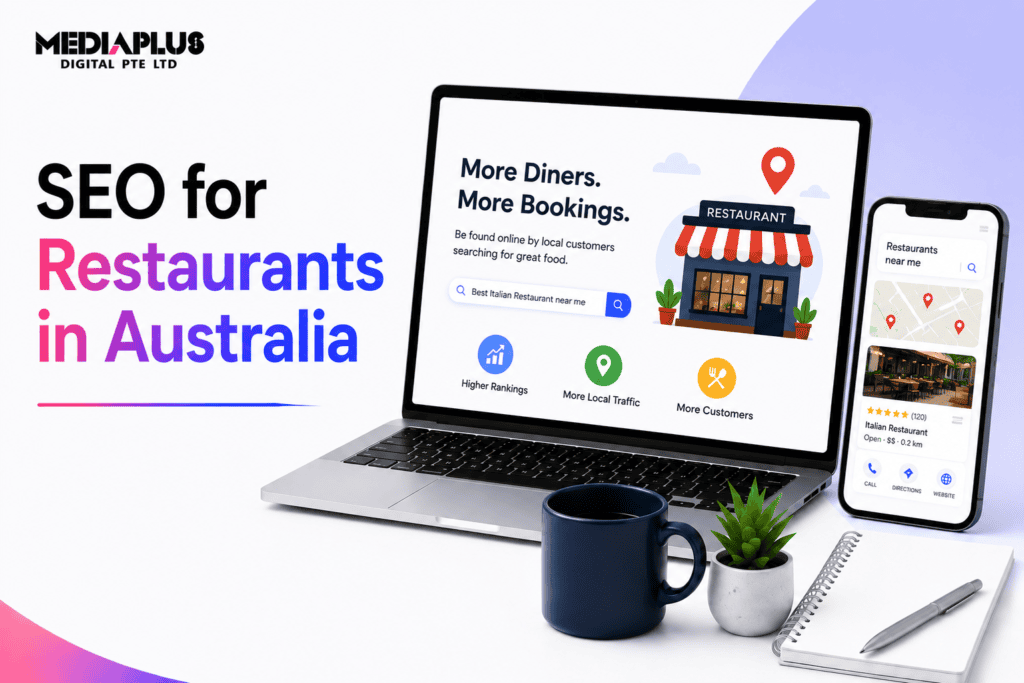
“Restaurants near me” draws around 107,000 searches a month in Australia, at essentially zero keyword difficulty.
That number is misleading in an important way. You cannot rank a web page for it. Google answers it entirely through the map pack, using proximity, prominence and relevance. Which means for a restaurant, the single most important SEO asset is not your website at all. It is your Google Business Profile.
This inverts the usual advice. Most SEO guides start with your site structure. For a restaurant, start with the profile, then fix the menu, then worry about pages.
Your Google Business Profile is the main event
Almost every diner decision now happens inside Google’s own interface: photos, rating, hours, price level, and whether it says “busy now”. Many people never reach your website.
Work through these in order:
Primary category, as specific as possible. “Italian restaurant” or “Vietnamese restaurant”, not “Restaurant”. The specific category is what makes you eligible for cuisine filtered searches, which are where the qualified traffic is.
Attributes, all of them. Outdoor seating, takeaway, dine in, delivery, wheelchair accessible, good for groups, accepts reservations, licensed, BYO, dog friendly, high chairs, live music. Each one is a filter someone uses. Leaving them blank removes you from those results.
Dietary attributes especially. Vegan options, vegetarian, halal, gluten free. These drive highly motivated searches and most restaurants leave them unset.
Hours, including public holidays. Set special hours for every public holiday. Australians search on public holidays constantly, Google surfaces “hours might differ” warnings, and a restaurant with confirmed holiday hours gets the click.
Photos, updated constantly. Restaurants are the most visual category in local search. Food photos, interior, exterior with signage so people can find the door, and the bar. Upload weekly rather than in one batch. Exterior shots matter more than owners expect, because people use them to recognise the place while walking.
Reservation and ordering links. Connect your booking system. Point the ordering link at your own online ordering, not the aggregator, for reasons covered below.
Posts. Specials, events, seasonal menus. Low effort and most competitors ignore them.
Our Google Business Profile optimisation checklist covers the full setup, and how Google’s local search algorithm works explains the map pack ranking factors.
Fix your menu, because it is probably invisible
This is the most common technical mistake in restaurant websites and it costs real traffic.
A menu as a PDF cannot be read properly by search engines. A menu as an image is worse, because it is invisible to them entirely. Yet a large share of Australian restaurant sites do exactly this.
Your menu should be HTML text on a page, with each dish name and description as real text. Then:
- Dish names become searchable. Someone searching “bun cha Richmond” or “wood fired pizza Fitzroy” can actually find you
- Dietary tags become filterable content
- Prices appear in search results
- The page can be updated without a designer
Keep a PDF version for download if you want, but never as the only version. Structure the page by section with proper headings, and add Menu schema.
If your menu changes seasonally, keep the same URL and update it rather than publishing a new page each season, so the page accumulates authority instead of splitting it.
The delivery commission problem
Australia’s delivery landscape narrowed sharply when Menulog ceased operations in November 2025 after twenty years, leaving Uber Eats and DoorDash as the two major marketplaces.
The economics are worth stating plainly. Uber Eats charges around 25% to 30% commission per order in Australia, and DoorDash ranges from about 15% to 30% depending on service level. Once additional fees are counted, the real cost commonly lands between 30% and 40% per order.
A restaurant doing $40,000 a month through a marketplace hands over roughly $12,000 of it, which is $144,000 a year.
The strategic response is not to leave the platforms. They deliver genuine incremental customers, particularly new ones. The response is to convert repeat customers to direct ordering, where the cost is a payment processing fee rather than a third of the order value.
That means:
- Online ordering on your own site, linked from your Google Business Profile ordering button
- A card or QR code in every delivery bag offering a small incentive to order direct next time
- Your own site ranking for “[your restaurant name] delivery”, so people searching your name find you rather than the aggregator listing
- Collecting email or SMS at the point of direct order
The parallel with other industries is exact. Marketplaces rent you customers. Direct channels let you own them. The difference compounds. Our explainer on lead generation covers building that owned channel, and the conversion rate optimisation checklist covers making the direct ordering path frictionless enough that people actually use it.
What your website should actually contain
Restaurants need fewer pages than most businesses, built well:
- Menu page, in HTML text, by section
- Location and hours page with parking, public transport, accessibility, and a photo of the entrance
- Bookings page with a working reservation widget
- Functions and events page. Covered below. This is the money page
- Online ordering, if you do takeaway or delivery
- About page with the story, the chef, the origin. Genuinely read in hospitality
- Cuisine or suburb page if you want to compete for “[cuisine] restaurant [suburb]” searches
Our guide to keyword mapping covers keeping those pages distinct, and what local SEO is covers the fundamentals.
Functions and events are where the margin is
A table of four is worth a couple of hundred dollars. A Christmas function for forty is worth several thousand, books months ahead, and comes with certainty.
Yet most restaurant websites bury private dining in a sentence on the About page.
Build a proper functions page covering capacity by configuration (seated, standing, whole venue), set menu options with per head pricing, minimum spend, AV and music, whether the space is private or semi private, photos of the space set up for an event, and an enquiry form that asks for date, headcount and occasion.
Timing matters enormously. Australian Christmas function enquiries begin in September and are largely done by early November. That page needs to be ranking by August, which means building it in autumn. A functions page published in November has missed the season.
The same applies to Melbourne Cup, EOFY functions in June, and Mother’s Day, which is one of the busiest restaurant days of the year and searched heavily in the fortnight before.
Reviews drive restaurant decisions more than any other category
Rating and review count are visible at the exact moment of choice, sitting next to your competitors in the same list.
Volume and recency both matter. A restaurant with 400 reviews at 4.4 generally beats one with 60 at 4.7, because volume reads as established and busy. Recency matters more in hospitality than elsewhere, because diners assume a restaurant reviewed well two years ago may have changed hands or chefs.
Reply to everything, especially the negative ones. A calm, specific, non defensive reply to a complaint is read by far more prospective diners than the complaint itself. Arguing with a reviewer is the single most damaging thing a restaurant owner can do online.
Ask for reviews at the table when the meal has gone well, or on the receipt. Do not offer discounts for them.
Schema markup for restaurants
Restaurants have unusually rich schema options, and using them properly can surface your price range, cuisine, hours and menu directly in results.
{
“@context”: “https://schema.org”,
“@type”: “Restaurant”,
“name”: “Your Restaurant”,
“servesCuisine”: “Vietnamese”,
“priceRange”: “$$”,
“telephone”: “+61-3-XXXX-XXXX”,
“address”: {
“@type”: “PostalAddress”,
“streetAddress”: “123 Example St”,
“addressLocality”: “Richmond”,
“addressRegion”: “VIC”,
“postalCode”: “3121”,
“addressCountry”: “AU”
},
“hasMenu”: “https://yourrestaurant.com.au/menu/”,
“acceptsReservations”: “True”,
“openingHoursSpecification”: [{
“@type”: “OpeningHoursSpecification”,
“dayOfWeek”: [“Wednesday”,“Thursday”,“Friday”,“Saturday”,“Sunday”],
“opens”: “17:00”,
“closes”: “22:00”
}]
}
Do not add AggregateRating markup using your Google reviews, which breaches Google’s guidelines on self serving review markup.
Local coverage still works in hospitality
Food media remains genuinely influential and is one of the few sectors where earned coverage moves bookings immediately. Broadsheet, Time Out, Concrete Playground, Good Food, local council what’s on listings, and suburb specific Instagram accounts all matter.
They also produce the kind of backlinks that lift your organic rankings, which our explainer on what backlinks are covers. A new menu, a new chef, an anniversary or a collaboration is a story. Pitch it.
Social is a genuine supporting channel in hospitality in a way it is not for most local businesses, since food is inherently visual. Our overview of the most popular social media platforms in Australia covers where your audience actually is.
Frequently asked questions
How do restaurants rank for “restaurants near me”?
Through the Google Business Profile, not a web page. Proximity, review volume and rating, category accuracy, photos and completeness are what determine map pack position.
Should my menu be a PDF?
No. A PDF menu is poorly read by search engines and an image menu is invisible to them. Publish the menu as HTML text and keep a PDF only as an optional download.
Is it worth being on Uber Eats and DoorDash?
For reach and new customers, usually yes. The problem is commission commonly landing between 30% and 40% of order value once all fees are counted. Use the platforms to acquire, then convert repeat customers to direct ordering.
How important are photos for restaurant SEO?
More than in any other local category. Diners choose visually, and profiles with frequent, recent, high quality photos get materially more engagement.
When should I promote Christmas functions?
The page should be live and ranking by August, since enquiries start in September and are mostly finished by early November.
Where to start
Complete every attribute on your Google Business Profile, set your public holiday hours for the next twelve months, and add photos this week. That is a two hour job that affects the 107,000 monthly “near me” searches more than anything on your website.
Then convert your menu from PDF to HTML text.
Our SEO and web design teams work with Australian hospitality businesses on visibility and direct ordering. Contact us for a review of your current setup.