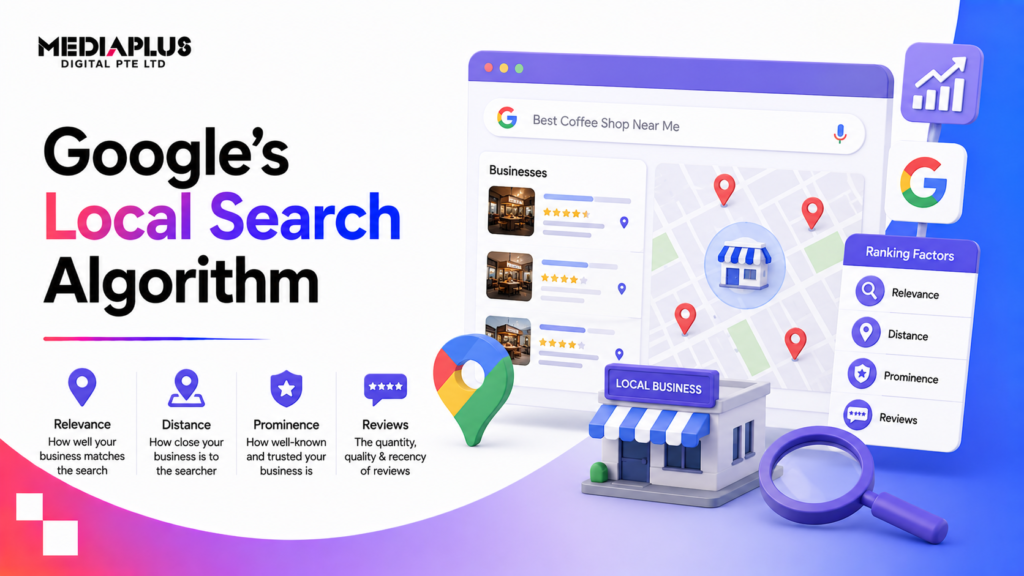
Type “coffee near me” or “plumber Fitzroy” into Google and you get a different page from a broad search like “best coffee brands”. Instead of ten blue links, a small map appears with three business listings underneath, complete with star ratings, opening hours and a directions button. That block is the local pack, and a separate set of rules decides who lands in it.
For any business that serves customers in a physical area, this is where the money is. People searching with local intent are usually close to buying. If your business is not showing up when they look, a competitor is taking that call.
This guide breaks down how the Google local search algorithm works, what the ranking factors are, and which levers you can pull to improve your position. It is built for Australian business owners and marketers who want something they can act on.
How local search differs from standard search
Standard organic search answers informational and navigational queries. Google looks at the whole web and returns pages ranked mostly on content quality and links.
Local search runs on top of that but adds a heavy dose of geography. When Google detects local intent, either from an explicit phrase like “near me” or “in Melbourne”, or from the query type itself (searches for “hairdresser” almost always imply a nearby one), it pulls in the Google Business Profile ecosystem and Maps data. Your website still matters, but a big share of the ranking now depends on your Business Profile rather than your web pages alone.
Two consequences follow. A business with a thin website can still rank in the local pack if its Business Profile is strong and it sits close to the searcher. And a business with a brilliant website can be invisible on the map if it never claimed or optimised its Profile. That split is why local SEO is treated as its own discipline. If you want the fundamentals first, our explainer on what local SEO is sets the scene before you go deeper here.
How the Google local algorithm works: relevance, distance and prominence
Google is unusually open about the local algorithm. Its own guidance names three core factors that decide local ranking: relevance, distance and prominence. Everything else you read about local ranking factors rolls up into one of these three.
|
Core factor |
What Google is measuring |
What it draws on |
|
Relevance |
How well your business matches what the person searched for |
Business categories, services listed, keywords on your Profile and website, review content |
|
Distance |
How far your business is from the searcher or the location in the query |
The user’s device location, or a named suburb or city in the search |
|
Prominence |
How well known and trusted your business is |
Reviews (count, rating, recency), backlinks, citations, overall web presence, engagement |
Google also states plainly that it does not rank businesses purely on proximity. A more prominent and relevant business slightly further away can outrank a closer one that looks weaker. This matters, because it means distance is not a wall you cannot get past. You can win a searcher who is a few suburbs away if your relevance and prominence are strong enough.
Think of the three factors as a combined score rather than a checklist. Distance sets the pool of candidates Google will consider. Relevance and prominence then sort that pool. Whitespark’s 2026 Local Search Ranking Factors report (published November 2025, based on a survey of 47 local search practitioners) points the same way: the strongest wins come from lifting relevance and prominence, because distance is the one input you cannot change.
The local pack, the local finder and organic results
These three surfaces look similar but behave differently, and knowing which one you are trying to win changes your priorities.
The local pack (or map pack) is the block of three business listings with a map that sits near the top of a local search. It is the most valuable real estate in local search because it appears above most organic links and carries click-to-call and directions buttons. Competition for those three spots is fierce.
The local finder is the expanded list you reach when you click “More places” or “View all” under the local pack. It shows a longer ranked list of businesses on Maps. Ranking well here still sends traffic, and it is a realistic target if you cannot crack the top three yet.
Local organic results are the standard blue-link results below the pack, filtered by local intent. Your website ranks here, not your Business Profile, and on-page content and links do most of the work. A single search page often shows all three surfaces at once, so a complete local strategy works on the Profile and the website together.
How the Business Profile feeds the algorithm
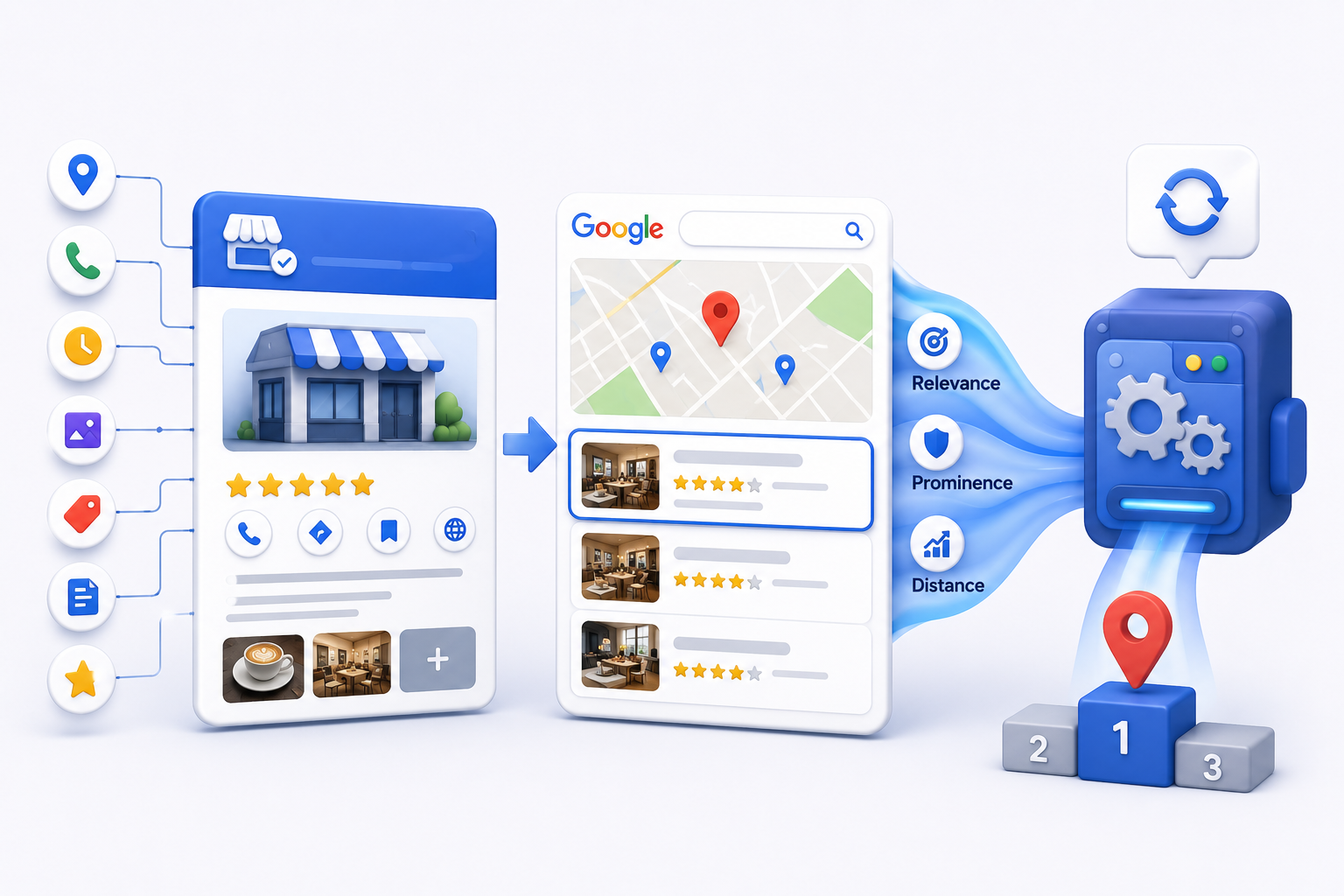
Your Google Business Profile is the record Google uses to represent your business on Maps and in the pack. It holds your name, address and phone number (NAP), categories, hours, photos, services, posts and reviews, and the algorithm reads it constantly. Two things matter most: the primary category is one of the heaviest relevance signals in the whole system, so picking “Cafe” versus “Coffee shop” changes which searches you show up for; and every field you leave blank is a signal you are not sending, because complete Profiles rank better than sparse ones.
Because the Profile does so much of the work, it deserves a structured setup. Work through our Google My Business optimisation checklist to make sure nothing important is missing.
Local ranking factors grouped by category
Whitespark’s 2026 report and BrightLocal’s analysis both break the local algorithm into weighted categories. The weights differ between the local pack and local organic results, which is the clearest evidence that these are two separate systems. Here is the picture from the 2026 data.
|
Factor category |
Local pack weight |
Local organic weight |
|
Google Business Profile signals |
~32% |
~7% |
|
Reviews |
~20% |
included in prominence |
|
On-page website signals |
~15% |
~33% |
|
Behavioural / engagement |
~9% |
~10% |
|
Links |
~8% |
~24% |
|
Citations (NAP) |
~6% |
~7% |
|
Personalisation / social |
~5% |
~12% |
Read the two columns side by side and the strategy writes itself. To win the map pack, the Business Profile and reviews carry the load. To win local organic, on-page content and links carry it. Most businesses need both.
Below is what sits inside each category and how to improve it.
Google Business Profile signals
These are the strongest lever for the local pack. Focus on:
- Primary and secondary categories. Choose the most specific primary category that describes your core service, then add relevant secondary categories.
- Complete information. Fill in services, attributes, opening hours (including public holidays), and a keyword-aware business description.
- Photos and posts. Add real photos regularly and publish Google posts about offers or news. Fresh activity signals a live business.
- Products and services. List them with descriptions so Google has more text to match against queries.
Reviews
Reviews have climbed to roughly 20% of the local pack signal in 2026, up from about 16% in 2023 according to Whitespark. They influence both prominence and relevance, because review text is scanned for keywords and location context. Work on:
- Volume and rating. A steady flow of genuine reviews with a healthy average beats a one-off burst.
- Recency. Whitespark flagged review recency as one of the most underrated factors. A wall of five-star reviews from three years ago carries less weight than fresh ones.
- Responses. Reply to reviews, good and bad. It shows engagement and gives you another place to use natural language.
- Keywords in reviews. You cannot script customers, but a prompt like “What did we help you with?” nudges useful detail into the text.
On-page website signals
This is the dominant factor for local organic and still meaningful for the pack:
- Create dedicated location and service pages with genuine, specific content, not the same paragraph with the suburb swapped out.
- Put your NAP in the footer and on a contact page, matched exactly to your Business Profile.
- Add LocalBusiness structured data so Google can read your details cleanly, and cover the questions local customers actually ask.
Our guide to on-page SEO walks through the technical and content elements in detail.
Links
Backlinks feed prominence for the pack and are a top-two factor for local organic. Local links carry extra weight: sponsorships of local clubs, events or charities that link back to you; local business associations, chambers of commerce and supplier or partner pages; and genuine coverage in local media or community blogs. Quality and local relevance beat raw volume here.
Behavioural and engagement signals
Google watches how people interact with your listing and site: clicks to call, direction requests, clicks through to your website, and how long visitors stay. You cannot fake these, but you earn them with clear photos, accurate hours and a fast, mobile-friendly website.
Citations and NAP consistency
A citation is any mention of your business name, address and phone number on another site, such as a directory. Consistency is the point. If your address reads three different ways across the web, Google trusts it less. Audit your listings and fix mismatches, especially on the major Australian directories.
For a broader run of quick wins across these areas, our SEO tips for small businesses is a good companion read.
Proximity: why you cannot control distance, and what to do instead
Distance is the one factor with no dial. You cannot move your shopfront to sit next to every searcher, and Google will always favour closer options for some queries. That is a constraint to plan around, not a flaw to fight. What you can do:
- Serve a realistic radius. Set your service area honestly in your Profile if you are a service-area business. Overreaching does not help.
- Win the relevance and prominence race in your zone. Since Google will consider you for searches within a reasonable distance, being the most complete, best-reviewed and most linked option in your area lifts you across that whole zone.
- Open or list additional locations if genuine expansion makes sense. Each real location gets its own Profile and its own shot at nearby searches.
The mistake is spending energy trying to rank where you have no physical presence. Concentrate on dominating the area you actually serve.
AI Overviews and the “near me” shift
Local search is changing shape. Two trends are worth planning for.
First, “near me” searches keep climbing as people trust Google to know where they are without typing a suburb. The lesson is not to stuff “near me” into your content, it never worked, but to make your location signals so clean that Google can place you accurately.
Second, AI Overviews now sit above or alongside traditional listings for many queries, and they pull from Business Profiles, reviews and structured content. Whitespark’s 2026 report added AI search visibility as a new factor category, with early data showing on-page content, reviews and citations feeding what the AI surfaces. The same fundamentals that win the pack are what get you cited by AI. This overlaps with generative engine optimisation, which we cover in our piece on what GEO is.
There is no separate playbook here. Solid local SEO is what makes you visible across the pack, organic results and AI answers at once.
Local ranking action checklist
Work through these in order for the fastest gains:
- Claim and verify your Google Business Profile if you have not already.
- Set the most specific primary category, then add relevant secondary categories.
- Complete every Profile field: services, hours, description, attributes and photos.
- Confirm your NAP is identical on your Profile, your website and your main citations.
- Build a review engine: ask every happy customer, respond to all reviews, keep them recent.
- Add LocalBusiness structured data and dedicated location or service pages to your site.
- Earn a handful of genuinely local backlinks each quarter.
- Publish Google posts and fresh photos regularly to keep the Profile active.
- Audit and clean up inconsistent citations across Australian directories.
- Track your pack position for your main keywords and adjust monthly.
Frequently asked questions
What are the three core factors of Google’s local search algorithm?
Relevance, distance and prominence. Relevance is how well you match the search, distance is how close you are to the searcher, and prominence is how well known and trusted your business is. Google names these three itself.
What is the difference between the local pack and organic results?
The local pack is the block of three business listings with a map, powered by Google Business Profiles. Organic results are the standard blue links below it, powered by your website. They rank on different factors, so you should work on both.
Can I control how far I am from a searcher?
No. Distance is fixed by your location and cannot be changed. What you can control is relevance and prominence, which is why a stronger, better-reviewed business can outrank a closer but weaker one within a reasonable radius.
How important are reviews for local ranking?
Very. In Whitespark’s 2026 report, reviews make up around 20% of the local pack signal, second only to the Business Profile itself. Volume, rating, recency and the keywords inside reviews all matter, so build a steady, ongoing review habit rather than a one-time push.
How long does it take to improve local rankings?
Profile fixes like categories and complete information can move rankings within a few weeks. Reviews, links and citations compound over months. Most businesses see meaningful change within three to six months of consistent work.
Does my website still matter if I have a good Business Profile?
Yes. Your website drives local organic results, feeds relevance and prominence for the pack, and supports AI Overviews. A strong Profile and a strong site reinforce each other.
What are citations and do they still count?
Citations are mentions of your business name, address and phone number on other sites, such as directories. They still contribute to prominence, and consistency is the key. Mismatched details across the web reduce the trust Google places in your business.
Getting help with local SEO
The Google local search algorithm is knowable, and every factor above is something you can work on. The hard part is doing all of it consistently while running a business.
If you would rather have a team handle the Profile, reviews, citations and on-page work together, our local SEO services are built for Australian businesses that want to own their map results. You can also explore our broader SEO services if you are chasing organic and local visibility at once. Get in touch for a look at where you stand and what it would take to reach the top three.