Quick answer: Australian advertisers pay roughly A 35 per thousand impressions on Instagram, with the all industry average around A 0.75 to A 1.47. Reels placements run materially cheaper than Feed. A realistic starting budget is A 30 a day, because below that the campaign cannot gather enough data to optimise.
Instagram ads are bought through Meta Ads Manager, in the same auction as Facebook. You are not buying a fixed rate. You are entering an auction where the price depends on who you want to reach, who else wants to reach them, and how good your ad is.
That is why “how much do Instagram ads cost” has no single answer, and why the number you should care about is not cost per click but cost per customer.
For Facebook specific figures see our guide to Facebook ads costs in Australia, and for the wider picture our breakdown of social media marketing costs in Australia.
The pricing models
|
Model |
You pay for |
Typically used for |
|
CPM, cost per thousand impressions |
Being seen |
Awareness, reach |
|
CPC, cost per click |
A click |
Traffic, consideration |
|
CPA, cost per action |
A conversion |
Leads, purchases |
Meta charges you on impressions or clicks, then reports your cost per result against whatever objective you chose. Cost per action is a calculated outcome rather than something you buy directly.
Australian benchmarks for 2026
Reported figures for the Australian market:
|
Metric |
Range |
Average |
|
CPM |
A35+ |
Around A$21.50 |
|
CPC |
A5.30 |
Around A$1.47 |
|
Cost per lead |
A275+ |
Varies heavily by industry |
Two trends worth noting. CPM rose roughly 20% year on year, from about A 21.50, and CPC rose about 12%. Australia is a Tier 1 advertising market, which means costs sit well above global averages. Comparing your account to a global benchmark will make it look worse than it is.
By industry
|
Industry |
CPM direction |
|
Finance and insurance |
Often above A$30 |
|
Professional services |
Above average |
|
Retail and ecommerce |
Around average |
|
Food and beverage |
Around A$12, well below average |
Cost per lead follows the same pattern, from around A 275 or more in financial services. High value industries pay more because competitors can afford to.
By placement
Placement choice is one of the few genuine cost levers available.
Reels run substantially cheaper than Instagram Feed, with reported CPMs around 45% lower for comparable reach on video native content. Feed and Stories sit higher, Explore varies.
The practical implication: if your creative works as short vertical video, Reels will stretch the same budget considerably further. If your creative is a static product image, forcing it into Reels will not perform and the saving is false.
These are reported market benchmarks compiled from Australian agency data and vary by source. Treat them as orientation, not as a quote.
What actually determines your cost
Audience size and specificity. Narrow audiences cost more per impression because you are competing for a smaller pool. Very broad audiences are cheaper per impression and often waste more.
Competition in your category. You are bidding against everyone targeting the same people. Finance and insurance advertisers can afford high costs, which lifts prices for everyone in that space.
Creative quality. The largest lever most advertisers ignore. Meta rewards ads people engage with by charging less to show them. A strong creative can halve effective costs against a weak one with identical targeting.
Objective. Awareness objectives are cheapest, conversion objectives most expensive, because Meta is doing more work to find people likely to act.
Seasonality. Australian costs spike from late October through December, driven by Black Friday, Christmas and Boxing Day. January is usually the cheapest month. If your product is not seasonal, buying in Q4 means paying retail competition prices for no reason.
Ad relevance and landing page. Where the click goes affects your cost per result even though it does not change the click price.
How much should you budget?
The technical minimum is around A$1 a day. That is not a useful number.
The practical minimum is A 30 a day, roughly A 900 a month. Below that, an ad set cannot exit Meta’s learning phase, which needs around 50 conversion events per week to optimise properly. Underfunded campaigns stay in learning indefinitely and perform badly, which is why small budgets often produce a false negative about the whole channel.
A workable starting structure:
|
Purpose |
Daily budget |
|
Testing three creatives |
A50 |
|
Scaling what works |
A200 |
|
Retargeting site visitors |
A20 |
Retargeting is almost always the cheapest conversions in the account and the first thing to set up.
Working backwards from what a customer is worth
The only budget calculation that matters:
- What is a customer worth to you? Say A$400
- What share of leads become customers? Say 25%, so a lead is worth A$100
- What can you afford per lead? Say A$50 to keep a healthy margin
- At a A 29
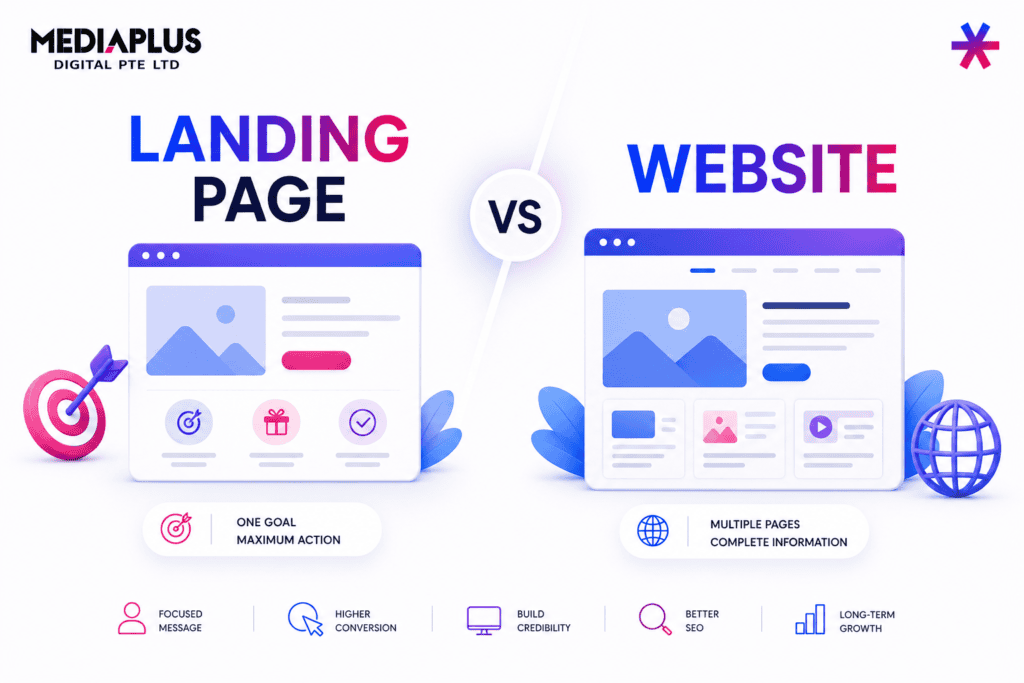
That works. Now change the landing page to 2% and the lead costs A$74, which does not. The destination page moves your economics more than your bidding does. Our comparison of landing pages and websites and the conversion rate optimisation checklist cover that side.
How to lower your costs
Improve the creative first. More leverage than any targeting change. Test three genuinely different concepts, not three colour variations. Video native content built for the platform outperforms repurposed print assets.
Use Reels placements where the creative suits vertical video.
Broaden slightly. Very narrow audiences drive up CPM. Meta’s targeting has become good enough that broader audiences with strong creative often outperform tight ones.
Set up retargeting properly, including site visitors, video viewers and profile engagers.
Avoid Q4 unless you sell into it. Costs rise sharply in November and December.
Fix the landing page. It does not lower cost per click but it lowers cost per customer, which is the number that matters.
Let campaigns run. Editing an ad set restarts the learning phase. Give changes at least a week.
Is Instagram advertising worth it?
Depends entirely on what you sell.
Works well for: visual products, fashion, homewares, beauty, food, fitness, hospitality, property, anything with an impulse or aspirational component, and retargeting warm audiences in any category.
Works poorly for: highly technical B2B, emergency services, and anything with a small, specific buyer group. Someone with a burst pipe is searching Google, not scrolling Instagram. For those, search advertising is the better first dollar. Our guide to Google Ads strategy covers that channel.
The honest framing: Instagram creates demand, search captures it. If nobody is searching for your product yet, Instagram is where you build that. If they are searching, start with search.
Frequently asked questions
How much do Instagram ads cost in Australia?
Around A 35 per thousand impressions with an average near A 0.75 to A 1.47. Costs vary substantially by industry and placement.
**Is 20 a day campaigns struggle to leave the learning phase.
How much should I spend on an Instagram ad?
Work backwards from customer value. If a customer is worth A 50 to A$100 per lead and should set the budget to produce the lead volume you want at that cost.
Can I buy Instagram ads without Facebook?
You can boost a post directly from the Instagram app, but proper campaigns run through Meta Ads Manager, which requires a linked Facebook Page. Boosting is simpler and gives you far less control.
Is it worth paying for Instagram ads?
For visual, consumer facing products, generally yes. For technical B2B or urgent services, search advertising usually returns more per dollar.
Why did my Instagram ad costs go up?
Common causes are seasonal competition, creative fatigue after an audience has seen the ad repeatedly, an edit that restarted the learning phase, or an audience that is too narrow.
Are Instagram ads cheaper than Facebook ads?
They run in the same auction, so it depends on placement and audience rather than platform. Reels placements are typically the cheapest option across both.
Where to start
Set a A$30 a day test budget across three genuinely different creatives, run it for two weeks without editing, and judge it on cost per lead rather than cost per click.
Before that, check where the clicks land. A campaign pointing at a homepage will produce disappointing numbers no matter how well it is targeted.
Our Instagram ads and social media advertising teams manage campaigns for Australian businesses. Get in touch for a review of your current spend.
Benchmarks are reported Australian market figures as at 2026, compiled from agency published data. Costs change with season, competition and account performance. Verify against your own account before budgeting.