Quick answer: A website is a set of connected pages that lets visitors explore, navigate and find whatever they came for. A landing page is a single standalone page built for one action, usually with navigation removed. Most businesses need a website. Businesses running paid advertising usually need both, because sending ad traffic to a homepage wastes budget.
There is a third term in this conversation that causes most of the confusion, and it is worth clearing up first.
Homepage. The front door of your website. It serves everybody, so it has to point in several directions at once.
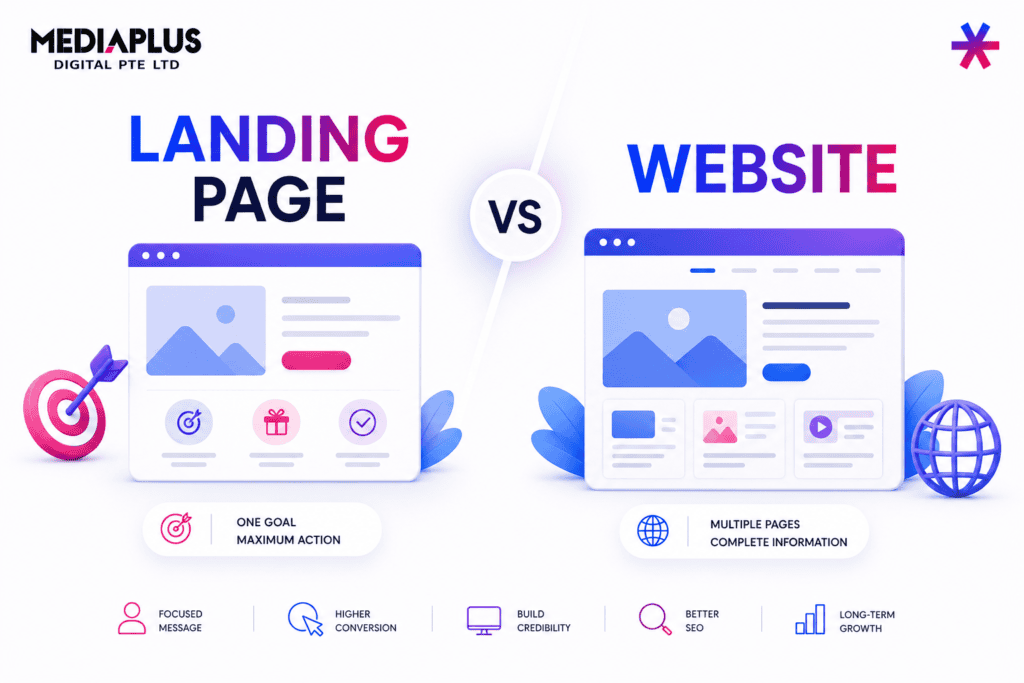
Website. The whole set of connected pages, with navigation, so visitors can move around and find what they want.
Landing page. One page, one purpose, usually with the navigation stripped out so there is nowhere to go except the action you want.
People often say “landing page” when they mean “homepage”. They are close to opposites. The homepage is designed to let people go anywhere. A landing page is designed to stop them going anywhere.
The core difference
|
Website |
Landing page |
|
|
Number of pages |
Many |
One |
|
Purpose |
Inform, explore, serve everyone |
One specific action |
|
Navigation |
Full menu |
Usually removed or minimal |
|
Audience |
Mixed, arriving from anywhere |
One segment, usually from one campaign |
|
Calls to action |
Several, varying by page |
One, repeated |
|
Typical use |
Ongoing presence, organic search |
Paid campaigns, launches, offers |
|
Measured by |
Traffic, engagement, enquiries overall |
Conversion rate on one action |
|
Lifespan |
Years |
Weeks to months, per campaign |
The defining feature of a landing page is what has been taken away. No menu, no footer links, no related articles, no “about us”. Every exit that is not the conversion has been closed. That sounds aggressive and it is, deliberately, because the visitor arrived from a specific ad about a specific thing and anything else is a distraction.
When you need a website
Almost always. A website is your permanent presence, and it does jobs a landing page cannot:
- Ranking in organic search. Landing pages are usually not built for SEO, are often noindexed, and cover one narrow topic. Ranking across a range of queries requires many pages
- Serving different audiences. Prospects, existing customers, job applicants, suppliers and journalists all arrive with different needs
- Establishing credibility. People check who you are, where you are, what you have done before. A one page ad does not satisfy that
- Supporting the whole buying journey, which for most services runs across several visits over weeks
If you only build one thing, build the website.
When you need a landing page
Landing pages earn their place in specific situations:
Paid advertising. This is the main one. Someone clicks an ad for “commercial air conditioning installation” and lands on your homepage, which talks about six services and asks them to explore. Most of them leave. A dedicated page about commercial air conditioning installation, with one enquiry form, converts far better on identical traffic.
A specific offer or campaign. A seasonal promotion, a free audit, a webinar registration, a downloadable guide.
A product or service launch, where the message needs to stand apart from the main site.
Testing demand before building anything larger. A single page plus a small ad budget will tell you whether people want the thing.
Different audiences for the same service. The same offer pitched to hospitality operators and to manufacturers needs different examples and different language.
Why this affects what your ads cost
This is the part most businesses do not realise, and it is a direct financial argument.
Google Ads assigns a Quality Score based partly on landing page experience, meaning how relevant and useful the destination page is for the search that triggered the ad. Higher Quality Score lowers your cost per click and improves ad position.
Sending every ad to your homepage means the page is generically relevant to everything and specifically relevant to nothing. That suppresses Quality Score, which raises your cost per click, which means you pay more for the same traffic and convert less of it.
A worked example. Say you run Google Ads with a $3,000 monthly budget at $5 per click.
|
Traffic to homepage |
Traffic to matched landing page |
|
|
Clicks |
600 |
600 |
|
Conversion rate |
2% |
7% |
|
Enquiries |
12 |
42 |
|
Cost per enquiry |
$250 |
$71 |
Same spend, same clicks. The only variable is where the traffic lands. Our guides to Google Ads costs in Australia and the Google Ads optimisation checklist cover the account side of this.
What goes on a landing page
The structure is deliberately narrow:
- Headline matching the ad. If the ad said “same day hot water replacement”, the headline says the same thing. Mismatch here is the most common cause of a landing page failing
- One clear offer stated in the first screen
- Proof. Reviews, logos, a specific number, a licence or certification
- What happens next, so the visitor knows what they are agreeing to
- The form, short. Four fields converts better than ten
- Repeat call to action further down for people who scroll
- No navigation menu. No footer link farm
Common mistakes: reusing the homepage hero, asking for information you do not need yet, adding links to other services, and burying the form below three screens of copy. Our conversion rate optimisation checklist and guide to calls to action cover the detail.
Cost and timeline in Australia
|
Landing page |
Website |
|
|
Build cost |
$800 to $4,000 |
$2,000 to $25,000+ |
|
Timeline |
3 days to 2 weeks |
4 to 12 weeks |
|
Ongoing |
Per campaign |
Hosting and maintenance |
|
Pages |
1 |
8 to 30 typically |
A landing page is cheap enough that if you are spending $2,000 a month on ads, building one is close to a rounding error against the return. Our breakdowns of website design prices in Australia and website development costs cover the larger builds.
Do they hurt each other?
A reasonable concern, and mostly no.
SEO. Landing pages built for paid campaigns are usually set to noindex, so they do not compete with your website in organic search. If you do want a page to rank, build it as a proper site page instead. Our guide to keyword mapping covers keeping pages from competing.
Brand consistency. Landing pages should look like they belong to you. Same logo, colours and tone. A landing page that looks like a different company reduces trust and conversions.
Where they live. Hosting landing pages on your own domain, usually in a subfolder, keeps trust signals intact. A separate domain for campaign pages looks suspicious to some visitors and splits any authority you build.
Which do you need?
|
Your situation |
What to build |
|
No online presence yet |
Website first |
|
Website exists, not running ads |
Improve the website, no landing page needed |
|
Running or starting paid ads |
Website plus one landing page per main service |
|
One specific offer or campaign |
Landing page |
|
Testing whether an idea has demand |
Landing page plus a small ad budget |
|
Ads running but few enquiries |
Landing pages, this is usually the problem |
That last row is worth pausing on. If traffic is fine and enquiries are not, adding budget makes it worse. The destination is the constraint.
Frequently asked questions
Is a landing page the same as a website?
No. A website is a set of connected pages with navigation. A landing page is a single page, usually with navigation removed, built for one action.
Is a landing page considered a website?
It can technically be a standalone site of one page, but in marketing usage it is a page built for a campaign, normally hosted within an existing website.
Do I need a website if I have a landing page?
For anything ongoing, yes. A landing page cannot rank across organic search, serve different audiences, or establish the credibility most buyers check before enquiring.
Is it better to have a landing page or a website?
They do different jobs. The website is your permanent presence. Landing pages are campaign tools. Businesses running paid advertising generally need both.
Can my homepage be a landing page?
It can receive ad traffic, but it will convert worse than a matched page, because it serves everyone rather than the specific person who clicked the ad.
How many landing pages do I need?
One per distinct offer or audience you advertise to. Three well matched pages beat one generic page covering everything.
Where to start
If you are not advertising, put the effort into the website. If you are advertising and sending traffic to your homepage, building one matched landing page for your highest spend service is usually the single most profitable change available to you.
Our landing page development team builds campaign pages for Australian businesses, and our web design and development team handles the full site. Get in touch and we will look at where your ad traffic is currently landing.
Costs are indicative as at 2026 and vary by scope and provider.