If you’re planning to run paid campaigns, one of the first questions you’ll ask is simple:
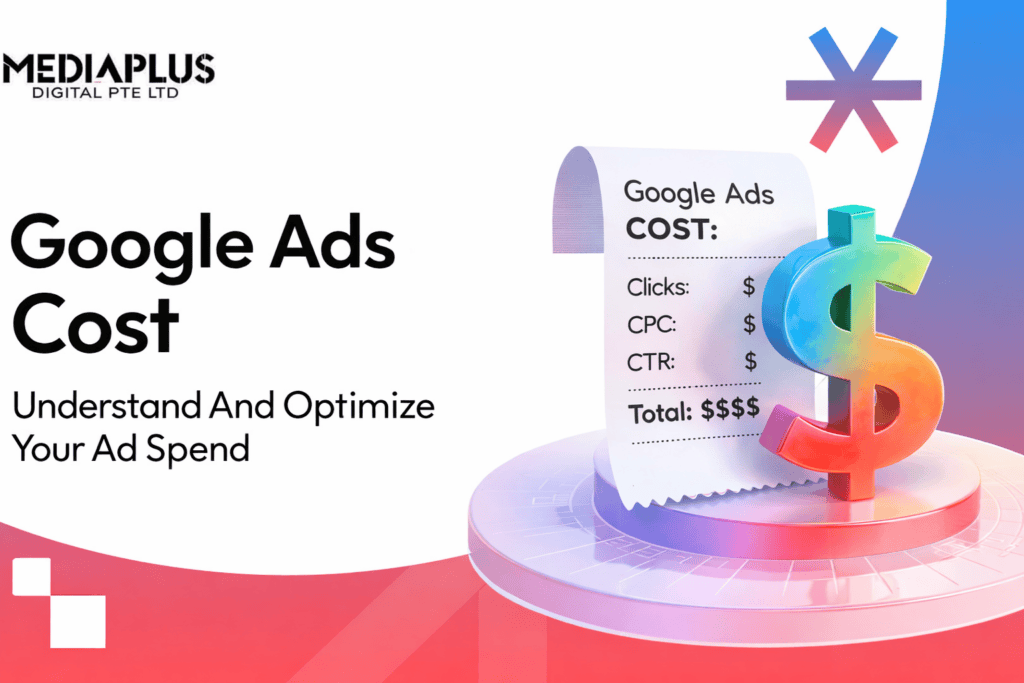
How much does Google Ads cost?
The honest answer is that it depends. Google Ads doesn’t have a fixed price. Instead, it operates on an auction system where costs vary based on competition, industry, and how well your campaigns are optimised.
However, to give you a realistic benchmark in Australia:
-
Average cost per click (CPC): $3 to $5 (can be much higher in competitive industries)
-
Average cost per conversion: $30 to $200+
-
Monthly ad spend for small businesses: $2,000 to $5,000+
-
Monthly management fees: $500 to $5,000
Understanding what drives these costs is key to controlling your budget and improving ROI.
How Google Ads Pricing Works
Google Ads runs on a real-time auction system.
Every time someone searches on Google:
-
Advertisers bid on keywords
-
Google evaluates ad quality and relevance
-
Ads are ranked based on Ad Rank (bid × quality score)
You don’t pay when someone sees your ad. You only pay when they click.
This means cost is not just about how much you bid, but how well your campaign is structured.
Key Factors That Influence Google Ads Cost
1. Keyword Competition
Keywords are the biggest cost driver.
-
High-intent keywords (e.g. “lawyer near me”) are expensive
-
Long-tail keywords are cheaper and often convert better
Industries like legal, finance, and insurance typically have the highest CPCs.
2. Quality Score
Google rewards relevant and high-quality ads.
Your Quality Score is based on:
-
Ad relevance
-
Expected click-through rate (CTR)
-
Landing page experience
Higher scores = lower cost per click and better ad positions.
3. Industry and Customer Value
Some industries can afford to pay more because each customer is worth more.
For example:
-
Legal services: very high CPC, high ROI per lead
-
eCommerce: lower CPC, but higher volume required
4. Location Targeting
Costs vary depending on where you advertise.
Major cities like:
-
Sydney
-
Melbourne
-
Brisbane
…usually have higher CPC due to stronger competition.
5. Device Targeting
Costs can differ across:
-
Mobile
-
Desktop
-
Tablet
User behaviour varies by device, which affects conversion rates and bidding strategies.
6. Bidding Strategy
Google offers multiple bidding options:
-
Manual CPC
-
Maximise clicks
-
Target CPA (cost per acquisition)
-
Target ROAS (return on ad spend)
Choosing the right strategy directly impacts your overall cost efficiency.
Google Ads Cost Breakdown
1. Cost Per Click (CPC)
Typical range:
-
Low competition: $1 to $3
-
Medium competition: $3 to $8
-
High competition: $10 to $50+
Some industries can exceed $100 per click.
2. Monthly Ad Spend
Typical budgets:
-
Small businesses: $2,000 – $5,000/month
-
Growing businesses: $5,000 – $15,000/month
-
Large campaigns: $20,000+/month
3. Management Costs
If you work with an agency, expect:
-
$500 – $1,500/month for basic campaigns
-
$1,500 – $5,000+/month for advanced management
This usually includes:
-
Campaign setup
-
Keyword research
-
Optimisation
-
Reporting
4. Additional Costs
Beyond ad spend, you may also need:
-
Landing page tools
-
Call tracking software
-
Analytics tools
-
Conversion tracking setup
These can add a few hundred dollars per month.
How to Reduce Google Ads Cost (Without Killing Performance)
Managing Google Ads cost is not about cutting your budget. It’s about improving efficiency so you get more results from the same spend.
Most businesses waste budget not because Google Ads is expensive, but because campaigns are poorly structured, targeting is too broad, or conversion paths are weak.
Below are practical, proven ways to reduce costs while improving performance.
1. Improve Quality Score (Your Biggest Cost Lever)
Your Quality Score directly affects how much you pay per click and where your ads appear.
Google rewards advertisers who provide better user experience. That means if your ads are relevant and your landing pages are strong, you can actually pay less than competitors while ranking higher.
To improve Quality Score, focus on:
-
Writing ad copy that closely matches the keyword
-
Using tightly grouped keywords (avoid mixing unrelated terms)
-
Improving click-through rate (CTR) with clear, compelling messaging
-
Ensuring your landing page matches the search intent
For example, if someone searches “affordable web design Sydney,” your ad and landing page should reflect that exact intent, not something generic.
A small improvement in Quality Score can significantly reduce CPC over time.
2. Target Long-Tail Keywords (Lower Cost, Higher Intent)
Many advertisers make the mistake of chasing high-volume keywords.
These keywords are:
-
More competitive
-
More expensive
-
Often less specific
Instead, focus on long-tail keywords, which are more detailed search queries like:
-
“affordable Google Ads agency for small business”
-
“best PPC service for ecommerce Australia”
These keywords typically:
-
Have lower CPC
-
Attract users closer to buying
-
Deliver higher conversion rates
While volume is lower, the quality of traffic is much higher, which improves overall ROI.
3. Use Geo-Targeting Strategically
Not all locations perform equally.
If you target broad areas without analysing performance, you may be paying for clicks that never convert.
Instead:
-
Identify high-performing cities or regions
-
Increase bids where conversions are strong
-
Reduce or exclude underperforming locations
For example, campaigns targeting Sydney or Melbourne may have higher CPC, but also higher conversion value. Meanwhile, some regions may generate cheap clicks but no real business outcomes.
Smart geo-targeting ensures your budget is allocated where it actually works.
4. Optimise Landing Pages (Where Most Budget Is Lost)
A lot of advertisers focus only on ads and ignore what happens after the click.
This is where most of your budget is wasted.
If your landing page is:
-
Slow
-
Confusing
-
Not aligned with the ad
…your conversion rate drops, and your cost per acquisition increases.
To fix this:
-
Ensure message match between ad and landing page
-
Improve page speed (especially on mobile)
-
Use clear headlines and strong calls-to-action
-
Remove distractions and unnecessary navigation
-
Add trust signals like reviews, testimonials, or guarantees
Even a small increase in conversion rate can dramatically reduce your cost per lead or sale.
5. Monitor and Optimise Campaigns Continuously
Google Ads is not something you set up once and leave running.
Without regular optimisation, performance will decline and costs will rise.
Key areas to monitor:
-
Search terms report (to find wasted spend)
-
Negative keywords (to block irrelevant traffic)
-
Ad performance (pause low-performing ads)
-
Bid adjustments (based on device, time, and location)
-
Conversion data (to scale what works)
For example, adding negative keywords can instantly stop irrelevant clicks and save budget.
Consistent optimisation is what separates profitable campaigns from expensive ones.
How to Turn Google Ads Cost into ROI
Spending money on ads is easy. Making it profitable is the real challenge.
To get strong results, businesses need to connect Google Ads with a broader performance system.
That usually involves combining:
-
Google Ads service to manage bidding, targeting, and optimisation
-
Landing page development to convert traffic into leads or sales
-
PPC service to manage and scale multi-channel paid campaigns
-
Digital marketing service to align ads with SEO, content, and funnel strategy
-
Conversion tracking & analytics to measure real performance
A provider like Mediaplus Digital Australia typically connects these elements into one system. Instead of running ads in isolation, they focus on improving the entire funnel, from click to conversion.
Final Thoughts
Google Ads cost is not fixed, and that’s actually a good thing.
It means:
-
You can start with a small budget
-
Scale based on performance
-
Optimise over time
What matters most is not how much you spend, but how efficiently you use that budget.
With the right strategy, even a modest Google Ads investment can generate strong, predictable returns and become a key driver of business growth.