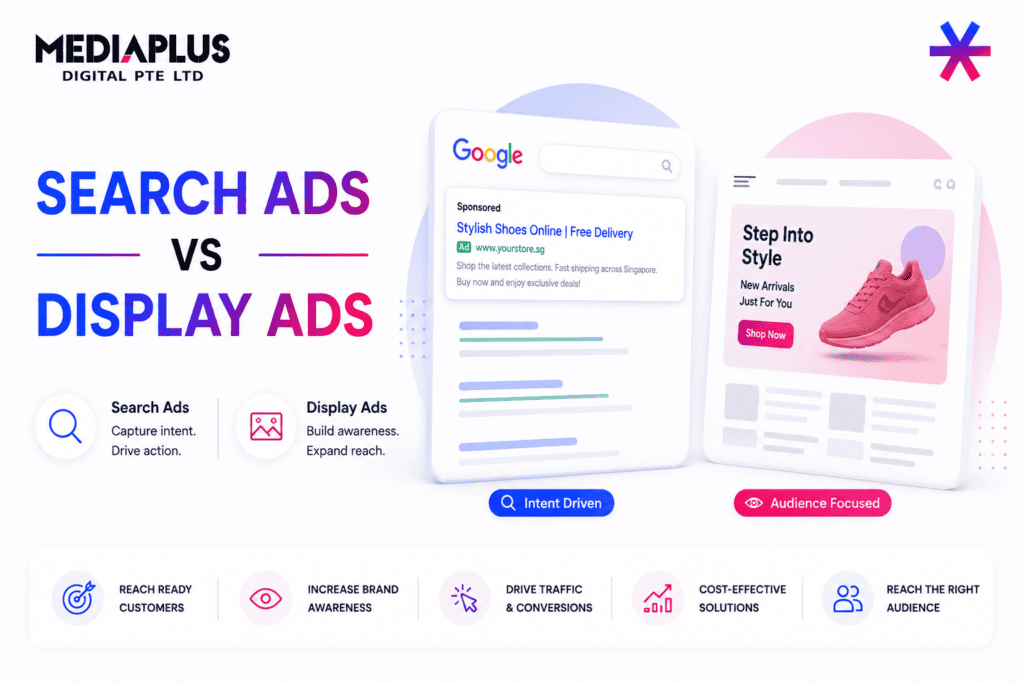
Search Ads and Display Ads sit on opposite ends of Google Ads. Search Ads are a pull channel: your text ad shows when someone types a query, so you are catching demand that already exists. Display Ads are a push channel: your visual banner appears on the websites, apps and videos people browse, so you are building demand and awareness before anyone goes looking.
Put simply, Search captures people who want what you sell right now. Display puts your brand in front of people who might want it soon. Most Melbourne businesses we work with do not pick one. They start with Search to bank the ready buyers, then add Display to widen reach and bring visitors back. The rest of this guide shows you how each format works, what it costs in Australia, and how to decide.
Search Ads vs Display Ads at a glance
|
Factor |
Search Ads |
Display Ads |
|
User intent |
High. The person is actively searching |
Low to medium. The person is browsing, not buying |
|
Ad format |
Text (headlines, descriptions, sitelinks) |
Visual banners, images, responsive and video units |
|
Where it appears |
Google search results page (SERP) |
Google Display Network: 3 million-plus sites, apps and YouTube |
|
Targeting basis |
Keywords and search terms |
Audiences, interests, demographics, placements, remarketing |
|
Funnel stage |
Bottom (consideration and decision) |
Top and middle (awareness), plus retargeting at the bottom |
|
Typical CPC (global, USD) |
~USD $2.69 average |
~USD $0.63 average |
|
Typical CPC (AUD guide) |
Often ~AUD $2 to $6 |
Often well under AUD $2, sometimes cents |
|
Average CTR |
~3% to 6% |
Usually under 1% (~0.46%) |
|
Best for |
Capturing existing demand, leads, direct sales |
Brand awareness, product launches, remarketing, visual products |
CPC and CTR figures are global averages from WordStream data compiled by Store Growers, updated January 2026. Global benchmarks are reported in USD; the AUD guide ranges are our own rough conversions for Australian planning and will vary by industry and competition. Treat every number as a starting benchmark, not a promise.
How Search Ads work
A Search Ad is a text listing that appears at the top or bottom of the Google results page, marked “Sponsored”. You bid on keywords, and when someone’s query matches your targeting, you enter an auction. Google weighs your bid against your Quality Score (a mix of expected click-through rate, ad relevance and landing page experience) to decide whether you show and in what position.
The thing that makes Search different is intent. Someone typing “emergency plumber Brunswick” or “commercial cleaning quote Melbourne” has a job to be done. Your ad meets them at the exact moment they want a solution, which is why Search reliably produces higher click-through and conversion rates than Display.
The trade-off is volume and price. You can only show to people who search your terms, so reach is capped by demand. And because competitors bid on the same high-intent keywords, cost per click runs higher. Search rewards tight keyword lists, sharp ad copy, and landing pages that match the promise in the ad.
If you want the wider view of every ad type in the platform, our guide to the different types of Google Ads breaks down where Search sits alongside Shopping, Performance Max and more.
How Display Ads work
Display Ads are the visual banners you see across the web: the image at the top of a news article, the box beside a recipe, the unit inside a mobile game or before a YouTube video. They run on the Google Display Network (GDN), which reaches more than 3 million websites and apps and, by Google’s own figures, over 90 percent of internet users worldwide.
Because there is no search query to match, Display targets people instead of keywords. You can reach audiences by:
- Interests and demographics, such as “in-market for a new car” or homeowners aged 35 to 54
- Placements, choosing specific sites, apps or YouTube channels
- Topics and keywords, aligning ads with page content
- Remarketing, the most valuable option for most advertisers, showing ads to people who already visited your site but did not convert
Remarketing is where Display earns its keep. A visitor reads your service page, leaves, then sees your banner over the next few days and comes back to enquire. For a deeper look at the format on its own, see what is display advertising. If you want reach beyond Google’s own network across programmatic exchanges, programmatic advertising extends the same idea to more inventory.
The trade-off: because you are interrupting people rather than answering a query, click-through and conversion rates are far lower. That is normal and not a failure of the channel. Display is measured on reach, view-through and assisted conversions as much as last-click sales.
Pros and cons of each
Search Ads: strengths
- Reaches people at the moment of intent, so conversion rates are strong
- Fast to launch and quick to show results
- Highly measurable, with clear keyword-to-sale tracking
- Works for lead generation and direct ecommerce sales
Search Ads: limits
- Reach is capped by how many people search your terms
- Higher cost per click on competitive keywords
- Text only, so no room for visual storytelling
- You compete for a small number of top positions
Display Ads: strengths
- Enormous reach for building awareness at a low cost per click
- Visual formats suit products that need to be seen (apparel, food, property, travel)
- The strongest home for remarketing
- Cheap traffic that supports upper-funnel goals
Display Ads: limits
- Low click-through and conversion rates by nature
- Ad fatigue and banner blindness reduce impact over time
- Weaker for capturing immediate, bottom-funnel demand
- Needs careful placement exclusions to avoid wasted spend on low-quality apps
When to use Search vs Display
Match the channel to the goal and funnel stage.
Choose Search when:
- People already search for what you offer (services, repairs, quotes, specific products)
- You need leads or sales now, not brand lift over months
- Your budget is limited and you want the highest intent traffic first
- You sell something urgent or considered, where the buyer is actively comparing
Choose Display when:
- You are launching a product or entering a new market where demand is low
- Your product benefits from being seen, not just described
- You want to remarket to people who visited but did not convert
- You need broad, affordable reach to warm up an audience
A useful rule: if demand exists, capture it with Search. If demand is thin, create it with Display. Many campaigns fail because the advertiser expects Display to behave like Search and judges it on last-click sales alone.
How they work together
Search and Display are not rivals. They cover different parts of the same buying journey.
- Display builds awareness. A prospect who has never heard of you sees your banner and registers the brand.
- Search captures the demand. Later, that same person searches your category, recognises your name, and clicks your Search Ad.
- Display brings them back. If they visit and leave without converting, remarketing banners follow them and pull them back to finish.
Run together, the two channels compound. Display seeds recognition that lifts Search click-through and brand-term volume, while Search converts the intent that Display helped create. For most advertisers the sequence is: start with Search to prove the offer converts, then layer remarketing Display, then broaden into prospecting Display once the funnel is working. Our Google Ads optimisation checklist walks through the settings that keep both campaign types efficient.
Typical costs in Australia
Costs vary widely by industry, location and competition, so use these as planning benchmarks rather than fixed prices.
- Search CPC: global average sits around USD $2.69 (Store Growers, Jan 2026). In Australian dollars, expect roughly AUD $2 to $6 for most local service and ecommerce terms, with competitive niches like legal, finance and trades running higher.
- Display CPC: global average around USD $0.63 (same source). In AUD terms this often lands well under $2, and remarketing clicks can be cents.
- Average CTR: Search sits near 3 to 6 percent; Display averages about 0.46 percent, so under one percent is normal and healthy.
- Conversion rate: Search averages roughly 3 to 6 percent against about 0.59 percent on Display, per the same benchmarks.
Your total budget matters more than any single CPC. A campaign spending AUD $2,000 a month on Search will behave very differently from one spending AUD $20,000. For a full breakdown of what advertisers here actually pay, read Google Ads cost in Australia. If you are still weighing paid ads against organic, our SEO vs PPC comparison covers the longer-term trade-offs.
Decision guide: which should you run?
Answer these in order.
- Do people search for what you sell? Yes, and you want conversions now: start with Search. No, or demand is low: start with Display to build it.
- Is your product visual? Strongly visual (fashion, homewares, travel, food): weight more budget to Display. Functional or urgent: weight to Search.
- Do you have site traffic to remarket? Yes: add a Display remarketing campaign regardless of the above. It is usually the highest-return Display you can run.
- What is the main goal? Leads or sales this quarter: Search first. Brand awareness or a launch: Display first, Search close behind.
- What is the budget? Tight: put it all on Search until it proves out, then expand. Comfortable: run both from the start and let the data reallocate.
Most Australian small and mid-sized businesses should open with Search, add remarketing Display within a month or two, then test prospecting Display once the numbers are solid.
Frequently asked questions
Are Display Ads worth it if the click-through rate is under one percent?
Yes, provided you judge them by the right metric. Display is about reach, awareness and remarketing, not last-click sales. A 0.46 percent CTR is normal for the network and does not mean the campaign is failing.
Which is cheaper, Search or Display?
Display has a much lower cost per click, often a fraction of Search. But cheaper clicks do not mean cheaper conversions, because Display traffic converts at a lower rate. Judge each on cost per conversion, not cost per click.
Can I run Search and Display in the same campaign?
It is possible through “Search with Display Select”, but we do not recommend it. Keeping them in separate campaigns gives you clean budgets, clean data and proper control over bidding for each network.
How much should I budget to start?
There is no single right number, but many local advertisers begin Search at around AUD $1,500 to $3,000 a month to gather meaningful data. See our Google Ads cost in Australia guide for detail by industry.
Do Display Ads help my Search performance?
They can. Display builds brand recognition, which tends to lift Search click-through rates and increase branded search volume over time. This is why running both often beats running either alone.
What is remarketing and which channel handles it?
Remarketing shows ads to people who already visited your site. It runs mostly on the Display Network and is one of the highest-return tactics available, because you are reaching warm prospects who already know you.
Should a brand-new business start with Display?
Usually only if demand for your category is genuinely low. If people already search for what you offer, start with Search to capture that intent, then add Display to build awareness once you have proof the offer converts.
Get the mix right for your business
Search and Display each do a job the other cannot. The skill is in the balance: how much to each, how to structure remarketing, and how to read the metrics that actually matter. If you would rather have that handled, our team runs Google Ads management for Melbourne and Australia-wide businesses, including Google Display Ads and full-funnel PPC campaigns. Reach out for a plan built around your goals and budget.