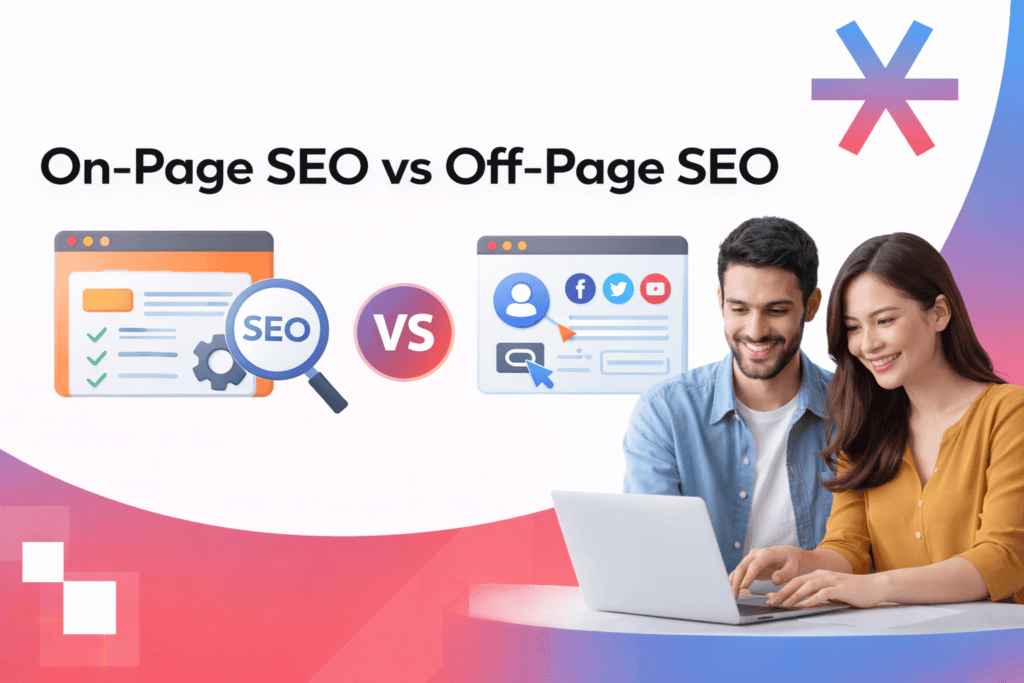
On-page SEO covers everything you change on your own website to help it rank, such as content, title tags, headings, internal links and structured data. Off-page SEO covers everything that happens away from your site that builds its authority and reputation, mainly backlinks, brand mentions, digital PR and reviews. Put simply, on-page work shapes what you rank for, and off-page work shapes how high you rank for it. Google weighs both, so a strong strategy uses them together rather than picking one.
Off-page vs on-page SEO at a glance
The fastest way to see the split is side by side.
|
On-page SEO |
Off-page SEO |
|
|
Definition |
Optimising elements on your own pages so search engines and readers understand them |
Building signals away from your site that raise its authority and trust |
|
What it controls |
Relevance: matching a page to the intent behind a search |
Authority: how credible and popular your site looks to Google |
|
Main activities |
Writing content, tuning title tags and headings, internal linking, image optimisation, schema markup |
Earning backlinks, digital PR, brand mentions, local citations, review generation |
|
Ranking signals |
Content quality and relevance, keyword coverage, HTML tags, site structure, page experience |
Quantity and quality of referring domains, anchor text, brand authority, review signals |
|
Level of control |
Direct. You can edit it today |
Indirect. You earn it through outreach and reputation over time |
|
Timeframe |
Faster. Changes can be recrawled and reflected within days to weeks |
Slower. Authority compounds over months of consistent effort |
|
Who does it |
Content writers, on-site SEO specialists, web developers |
Link builders, PR and outreach teams, brand and social managers |
Neither column wins on its own. On-page SEO sets the ceiling for how high a page can realistically rank, and off-page SEO is what pushes it toward that ceiling.
On-page SEO in brief
On-page SEO is the part you own outright. You can log in and change it whenever you like, which is why most Australian businesses start here. The goal is to make each page unmistakably relevant to the search it targets and easy for both people and crawlers to read.
The core elements:
- Title tags that lead with the primary keyword and read as a clear promise, kept under roughly 60 characters so they do not truncate.
- Headings (H1 to H3) that give the page a logical outline and use natural variations of the topic.
- Content that answers the query fully, covers the subtopics real searchers expect, and adds something the current top results miss.
- Internal links that pass relevance between related pages and guide readers to the next logical step.
- URL structure that is short, readable and descriptive.
- Image optimisation with compressed files and descriptive alt text.
- Schema markup that helps Google interpret the page and can earn rich results such as FAQs, reviews or breadcrumbs.
For the full walkthrough with examples and templates, read our deep dive on what is on-page SEO. If you want the wider context, our guide to what is SEO explains how these pieces sit inside the broader discipline.
Off-page SEO in brief
Off-page SEO is everything that signals to Google that other people trust your site. You cannot edit it directly. You earn it. The biggest lever is backlinks, and it is not close: Ahrefs analysed over a billion pages and found the number of referring domains pointing to a page correlated with higher rankings more strongly than any other factor they measured (Ahrefs, 2020). The same study found that 90.63% of pages get no organic traffic from Google at all, and a shortage of backlinks was a common thread among them.
The main off-page activities:
- Backlinks from relevant, credible websites. Quality and topical relevance matter far more than raw volume. If the concept is new to you, start with our explainer on what are backlinks.
- Brand mentions, including unlinked ones, which help Google associate your brand with a topic and market.
- Digital PR, where you earn coverage and links by creating something newsworthy, such as original data or specialist commentary.
- Local citations, meaning consistent name, address and phone details across directories, which matter a great deal for businesses serving a specific area.
- Reviews and ratings on Google Business Profile and third-party sites, which feed trust and, for local searches, rankings.
Our companion post on what is off-page SEO covers link building tactics, outreach and digital PR in full.
Technical SEO: the third pillar
On-page and off-page get most of the attention, but they sit on top of a third pillar. Technical SEO makes sure search engines can actually crawl, render and index your pages, and that those pages load fast and work on mobile. Common technical factors include crawlability and XML sitemaps, site speed and Core Web Vitals, mobile responsiveness, HTTPS, canonical tags to manage duplicate content, and clean site architecture.
Here is the practical link between all three: the best content and the strongest backlink profile still underperform if Google cannot crawl the page or it takes eight seconds to load. Technical SEO removes the friction so your on-page and off-page work can pay off. For the complete list, see our technical SEO guide for 2026.
The key factors on each side
|
On-page factors |
Off-page factors |
|
Content relevance and depth |
Referring domain quantity and quality |
|
Keyword targeting and coverage |
Anchor text of inbound links |
|
Title tags and meta descriptions |
Brand mentions and searches |
|
Heading structure |
Digital PR and media coverage |
|
Internal linking |
Local citations (NAP consistency) |
|
Image alt text and compression |
Google Business Profile signals |
|
URL structure |
Reviews and ratings |
|
Structured data (schema) |
Social visibility |
How they work together and where to focus first
Think of it as a two-part equation. On-page SEO tells Google what your page deserves to rank for. Off-page SEO tells Google how much authority stands behind that claim. A page can be a perfect answer and still lose to a weaker page on a more trusted domain, and a high-authority domain can still fail to rank a page that does not match the query. You need both sides moving.
For most Australian businesses, the order is clear. Fix the foundations first, then build authority:
- Sort technical basics so pages can be crawled, indexed and loaded quickly. There is no point earning links to a page Google struggles to read.
- Get on-page right across your money pages and key content. This is the work you fully control and it usually produces the quickest movement.
- Then invest in off-page through link building and digital PR to lift pages that already deserve to rank but sit just off page one.
The exception is competitive commercial keywords. If your on-page and technical work is already solid and you are stuck behind established competitors, the gap is almost always authority, and off-page becomes the priority. A quick audit of the top-ranking pages usually shows which lever is holding you back.
Action checklist
On-page
- Every target page has a unique title tag leading with its primary keyword
- Headings follow a logical H1 to H3 outline
- Content covers the subtopics searchers expect and beats the current top results on usefulness
- Internal links connect related pages with descriptive anchors
- Images are compressed and have alt text
- Relevant schema is in place
Off-page
- You know your referring domain count versus your top three competitors
- A repeatable way to earn links exists, such as digital PR or resource content
- Google Business Profile is claimed and complete
- Name, address and phone details are consistent across local directories
- You actively ask satisfied customers for reviews
Technical
- Key pages are indexable and appear in an XML sitemap
- Core Web Vitals pass on mobile
- HTTPS is enabled site-wide
- Canonical tags handle duplicate or near-duplicate pages
For a single running list that ties all three together, use our SEO checklist, and pair it with the right SEO tools to track progress.
FAQ
Is on-page or off-page SEO more important?
Both matter and Google uses both. On-page determines what you can rank for and off-page determines how high. If you are forced to choose a starting point, on-page and technical come first because they set the ceiling; off-page raises you toward it.
What is the main difference between on-page and off-page SEO?
On-page SEO happens on your own website and you control it directly. Off-page SEO happens away from your site and you earn it, mostly through backlinks, brand mentions and reviews.
Are backlinks on-page or off-page?
Backlinks are the central off-page signal. Ahrefs found referring domains correlated with rankings more than any other factor they measured (Ahrefs, 2020). Internal links, by contrast, are an on-page factor because they live on your own site.
Where does technical SEO fit in?
Technical SEO is a third pillar that supports the other two. It makes your site crawlable, fast and mobile-friendly so your on-page content and off-page authority can actually take effect.
How long does each take to show results?
On-page changes can show within days to a few weeks once Google recrawls the page. Off-page results are slower because authority builds over months of consistent link earning and reputation work.
Can I rank with only on-page SEO?
For low-competition and long-tail terms, strong on-page and technical work is sometimes enough. For competitive commercial keywords, you will usually need off-page authority to compete with established sites.
Should a small local business bother with off-page SEO?
Yes, and it looks a little different for you. Local citations, Google Business Profile and reviews often move the needle faster than broad link building, which is why local SEO leans heavily on off-page signals.
Where to go from here
On-page, off-page and technical SEO are three parts of one system, not competing choices. Get the balance right and each one multiplies the others. If you would rather have a team map the gaps and run all three, our SEO service helps Melbourne and wider Australian businesses turn the audit into rankings. Get in touch for a look at where your quickest wins sit.