Quick answer: Choose native when performance or hardware access is central to the product, and you can fund two codebases. Choose cross platform, meaning Flutter or React Native, for most business apps, because it delivers close to native quality from one codebase. Choose hybrid when speed and budget matter more than polish. Choose a progressive web app when install friction is your biggest problem.
The question is usually framed as hybrid versus native, which leaves out the two options most Australian businesses should actually be considering. There are four approaches, not two, and the gap between them has shifted considerably in the last few years.
This guide compares all four, then gives you a set of questions that settle the decision.
The four approaches
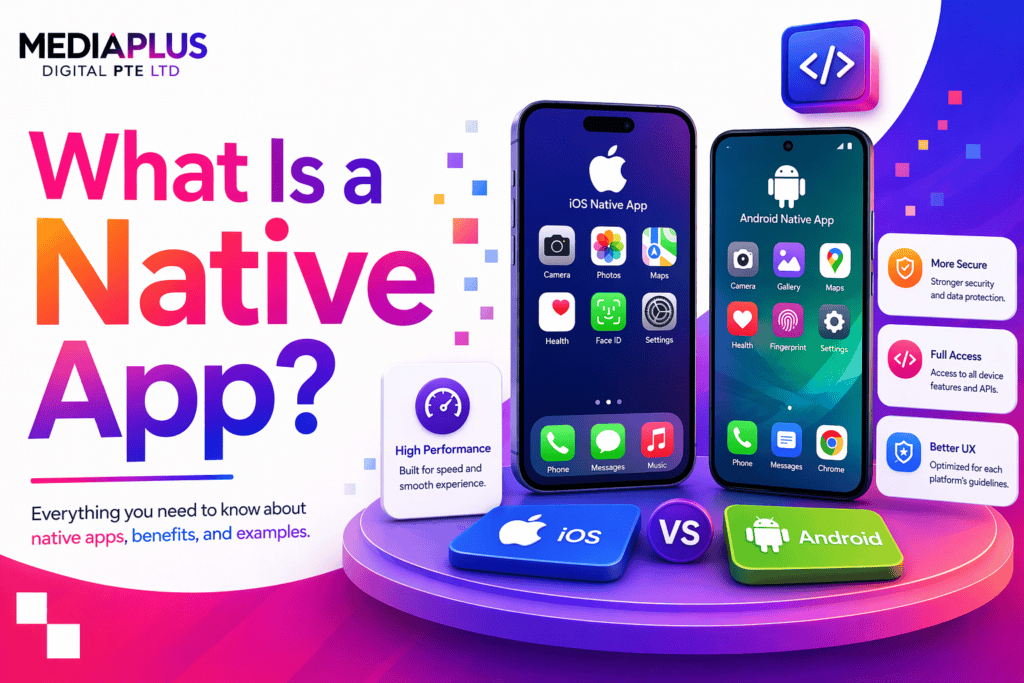
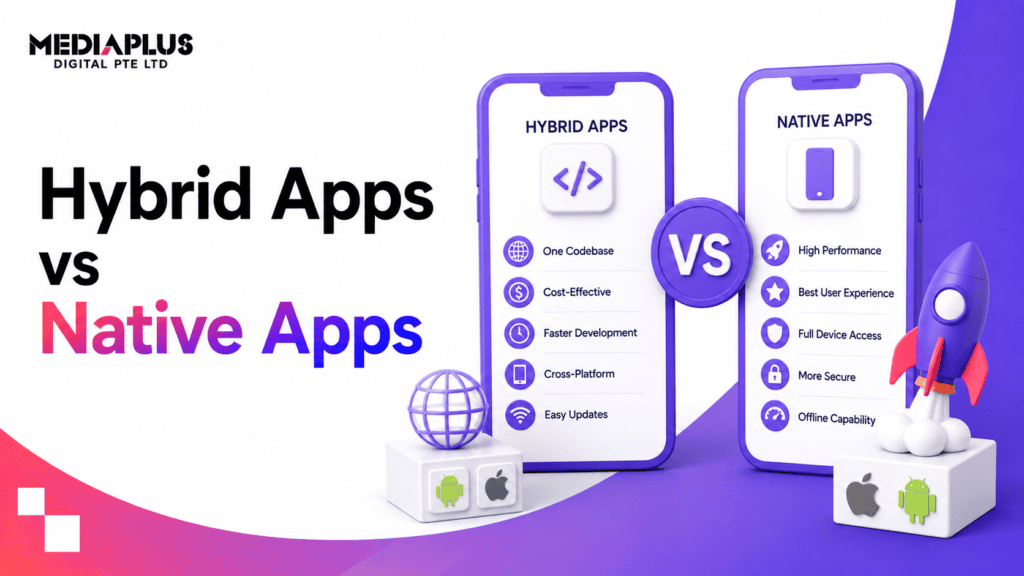
Native. A separate app per platform, written in the platform’s own language. Swift for iOS, Kotlin for Android. Compiled directly, full device access, best performance, two codebases. Covered in detail in what is a native app.
Cross platform. One codebase compiled to both platforms. Flutter, from Google, uses Dart and renders its own interface. React Native, from Meta, uses JavaScript and renders actual native components. Both produce apps that most users cannot distinguish from native.
Hybrid. A web application wrapped in a native shell that can be installed from an app store. Ionic and Capacitor are the common tools. The interface is HTML and CSS running in an embedded browser view.
Progressive web app. A website with app like behaviour: installable to the home screen, works offline, can send push notifications on most platforms. No app store involved.
Side by side
|
Native |
Cross platform |
Hybrid |
PWA |
|
|
Codebases |
Two |
One |
One |
One |
|
Performance |
Best |
Very good |
Adequate |
Adequate |
|
Device access |
Full, immediate |
Most, via plugins |
Limited, via plugins |
Limited |
|
Feels like the platform |
Yes |
Close |
Noticeably not |
No |
|
Build cost |
Highest |
Moderate |
Lowest |
Lowest |
|
Time to first release |
Longest |
Moderate |
Fast |
Fast |
|
App store presence |
Yes |
Yes |
Yes |
No |
|
Updates |
Store review each time |
Store review each time |
Store review, some content over the air |
Instant |
|
Maintenance burden |
Two of everything |
One codebase |
One codebase |
One codebase |
|
Offline capability |
Best |
Good |
Good |
Limited but improving |
Cost and timeline in Australia
Indicative, as at 2026, for a standard business app on both platforms:
|
Approach |
Build cost |
Timeline |
Annual maintenance |
|
Native, both platforms |
$120,000 to $300,000 |
8 to 16 months |
15% to 20% of build |
|
Cross platform |
$70,000 to $180,000 |
4 to 9 months |
15% to 20% of build |
|
Hybrid |
$40,000 to $100,000 |
3 to 6 months |
10% to 15% of build |
|
PWA |
$25,000 to $70,000 |
2 to 4 months |
Lower |
The cross platform saving is real but smaller than the “one codebase means half the cost” claim suggests. Platform specific work, testing on both, and store submission still have to happen. Expect a saving of roughly 30% to 40% against native for both platforms rather than 50%.
Our breakdown of app development costs in Australia covers the variables in more detail.
The questions that settle it
Work through these in order. The first one that gives a firm answer usually decides it.
1. Does the app depend on hardware or heavy processing?
Camera processing, background location tracking, Bluetooth peripherals, AR, health sensors, offline maps, video editing, real time graphics.
If yes: native, or cross platform with native modules for the demanding parts. Hybrid will disappoint you.
If no: continue.
2. Is the app the product, or a channel to it?
If people will use it daily and judge your business by how it feels, quality is not negotiable. If it is a convenient way to access a service they buy anyway, adequate is adequate.
If the app is the product: native or cross platform.
If it is a channel: hybrid or PWA is likely enough.
3. Do you actually need to be in the app stores?
Store presence provides discovery, credibility, and push notifications. It also brings review delays, commission on in app purchases, and ongoing compliance.
If store presence does not matter, a PWA removes the entire distribution problem. This suits internal tools, B2B portals and anything where you already have the relationship and just need people to reach it quickly. A PWA is closer to a website than an app, so the same rules apply: our guides to responsive web design best practices and Core Web Vitals are the relevant reading.
4. What can you maintain?
This is the question most businesses skip, and it is the one that hurts later.
An app needs ongoing work: annual operating system updates, security patches, store policy changes, device compatibility. Two native codebases means doing all of that twice, indefinitely.
Be honest about whether you will fund that. An unmaintained native app on two platforms becomes a liability faster than a single cross platform codebase.
5. How fast do you need to learn whether this works?
For a first version testing demand, speed of learning beats polish. Ship something adequate, find out whether anyone uses it, then invest in quality once you know.
If you are validating: hybrid or PWA, then rebuild if it works.
What we usually recommend
For Australian businesses commissioning their first app:
Cross platform, using Flutter or React Native, is the right default. It covers both platforms from one codebase, performs well enough that users do not notice, keeps maintenance manageable, and costs meaningfully less than native twice over. For the large majority of business apps, this is the answer.
Go native when hardware or performance is genuinely central, or when the app is your primary product and experience is your differentiator.
Go hybrid when budget is tight, the app is essentially a wrapper around content or forms, and you accept it will not feel like a native app.
Go PWA when installation friction is your real problem, or when you need to update constantly without waiting for store review.
Common mistakes
Choosing an agency on price alone. App projects fail on communication and scope more often than on code. Our guide to choosing app development companies covers what to check.
Choosing native because it sounds better. Native is a cost decision, not a status one. Paying twice for a business app nobody judges on animation smoothness is waste.
Choosing hybrid purely on price, then being surprised. Hybrid apps feel like websites in a frame, because that is what they are. If your stakeholders expect it to feel like Instagram, set expectations before the build.
Forgetting maintenance in the budget. The build is the beginning. Budget 15% to 20% annually from day one.
Building an app when a website would do. The most expensive mistake available. Nobody installs an app to book one appointment a year. If your interaction is occasional, invest in a fast mobile first website instead.
Skipping the strategy step. Deciding the technology before deciding what the app is for produces expensive rework. Our guide to app development strategy covers the sequence.
Frequently asked questions
What is the difference between a hybrid app and a native app?
A native app is built in the platform’s own language and compiled to run directly on the device. A hybrid app is a web application running inside a native wrapper, using one codebase for both platforms.
Are hybrid apps slower than native apps?
Yes, though for simple business apps the difference is often not noticeable. It becomes obvious with heavy animation, large lists, complex graphics or intensive processing.
Is React Native hybrid or native?
Neither exactly. React Native is cross platform: one JavaScript codebase that renders genuine native components. It sits between hybrid and native, closer to native in the result.
Is Flutter better than React Native?
They are comparable. Flutter renders its own interface, giving consistent results across platforms and strong performance. React Native uses native components and has a larger JavaScript talent pool. Team skills usually decide it more than technical merit.
Which is cheaper, hybrid or native?
Hybrid, substantially. A hybrid build for both platforms typically costs a third to a half of native for both, with cross platform sitting between them.
Can I start hybrid and move to native later?
Yes, and it is a reasonable strategy for validating an idea. Budget for it as a rebuild rather than a migration, because very little code carries across.
Where to start
Answer the five questions above before talking to any developer. Most disagreements about app technology are actually disagreements about what the app is for.
Then check the maintenance number against your budget, because that is the commitment people underestimate.
Our mobile app development team builds for Australian businesses across all four approaches, and will tell you if a website would serve you better. Get in touch to work through the decision.
Costs are indicative as at 2026 and vary by scope and provider.