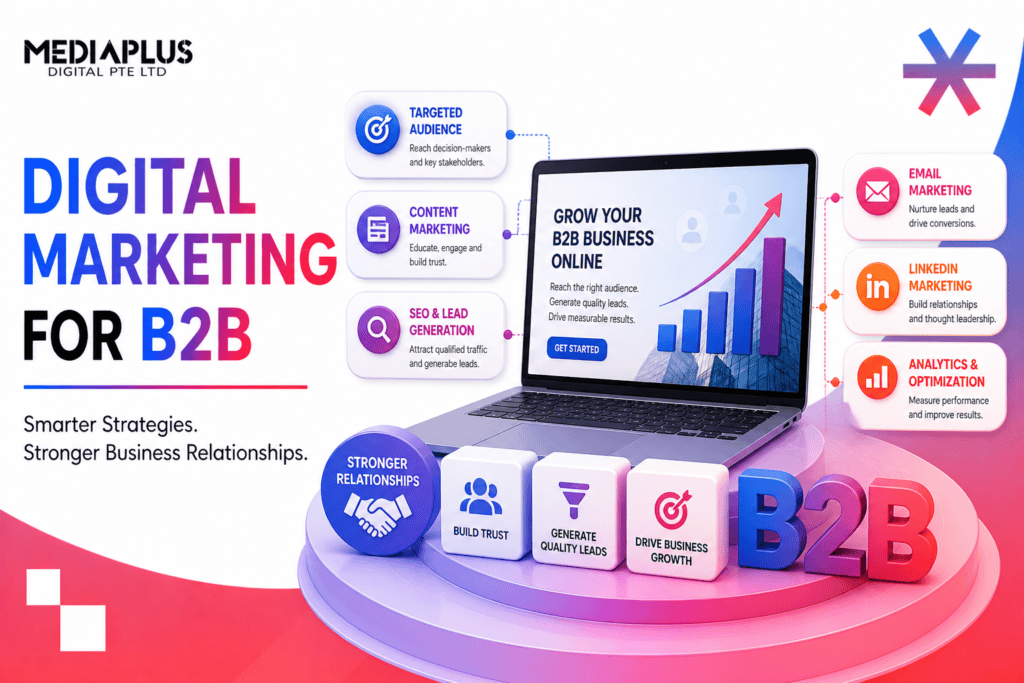
Quick answer: B2B digital marketing means using search, content, email, LinkedIn and paid channels to reach business buyers across a long, committee driven purchase. The channels that consistently produce pipeline for Australian B2B firms are search (SEO plus Google Ads on high intent terms), LinkedIn, and email to a database you own. Attribution is harder than in B2C because the buying group is larger than the person who fills in your form.
B2B digital marketing fails for a predictable reason: people run it like B2C with different words.
In B2C, one person decides, usually quickly, often emotionally, and the purchase is small enough to reverse. In B2B, five to ten people are involved, the cycle runs three to eighteen months, the decision is defensible rather than emotional, and the person who fills in your form is frequently not the person who signs.
Every channel decision below follows from that.
What is different about B2B
|
Factor |
B2C |
B2B |
|
Decision makers |
One |
Typically 5 to 10 |
|
Cycle length |
Minutes to days |
3 to 18 months |
|
Deal value |
Low |
High |
|
Motivation |
Want |
Risk reduction and business case |
|
Volume of prospects |
Large |
Small and identifiable |
|
Attribution |
Reasonably clean |
Genuinely messy |
That last row matters more than people expect. The CFO who blocked your deal never visited your website. The engineer who championed you read six of your pages nine months ago and searched your brand name directly when the budget appeared. Your analytics will record that as direct traffic.
The channels, ranked by what they actually produce
1. Search, on high intent terms
The highest quality B2B leads come from people searching for a solution to a defined problem. They have a budget and a timeline.
SEO is where the compounding happens. Build one page per problem you solve, not one page per product feature. B2B buyers search symptoms and outcomes, not your internal product names.
The pages that work in B2B:
- Problem pages (“reduce warehouse picking errors”)
- Comparison pages (“[category] software compared”)
- Alternative pages (“alternatives to [incumbent]”)
- Integration pages, if you connect to systems buyers already run
- Industry pages, because buyers want to see you understand their sector
- Pricing or how we price, which most B2B firms refuse to publish and which buyers search constantly
Google Ads covers what SEO cannot reach yet. In B2B the volumes are small and the cost per click is high, which is fine because the deal value is high. Bid on category and competitor terms, not broad awareness terms. Our guides to Google Ads costs in Australia and SEO versus PPC cover the split, and what SEO is plus the SEO checklist cover the groundwork.
2. LinkedIn
The only channel where you can target by job title, company size, industry and seniority with real accuracy. That precision is worth the cost per click, which is materially higher than other platforms.
What works: thought leadership from real people rather than the company page, targeted content promotion, and retargeting site visitors. What does not work: broadcasting product features to a cold audience.
3. Email to a database you own
Because the cycle is long, the ability to stay present for twelve months without paying for each impression is the highest leverage asset in B2B marketing.
This requires something worth subscribing to, which for B2B usually means genuinely useful analysis rather than product news. The test: would a prospect forward it to a colleague?
4. Content that supports the buying committee
The champion inside the business has to sell you internally to people you will never speak to. Give them the material to do it:
- A business case template or ROI calculator
- Security and compliance documentation
- Implementation timelines
- Case studies from similar companies, with numbers
- Comparison content that treats competitors fairly
Content that helps a champion win an internal argument outperforms content that describes your features.
5. Where B2B budget is usually wasted
- Broad awareness display advertising. Rarely justifiable at B2B volumes
- Vanity social. Posting on channels your buyers do not use professionally
- Gating everything. Gating your best content behind a form reduces the reach that builds familiarity. Gate the tools and templates, not the thinking
- Chasing traffic volume. A B2B site with 800 well qualified monthly visitors can outperform one with 20,000 unqualified ones
Match the content to the buying stage
|
Stage |
What the buyer is doing |
What to give them |
|
Problem aware |
Recognising something is wrong |
Educational content, diagnostics, benchmarks |
|
Solution aware |
Researching approaches |
Category explainers, comparison frameworks |
|
Vendor aware |
Building a shortlist |
Case studies, pricing, integration detail |
|
Validation |
Justifying the decision internally |
ROI models, security docs, references |
|
Post sale |
Onboarding and expanding |
Support content, expansion use cases |
Most Australian B2B websites are built entirely for the vendor aware stage and have nothing for the two stages before it, which is where the buyer forms their shortlist. Our guide to top, middle and bottom of funnel content covers structuring this, and the AIDA model covers the underlying progression.
Account based marketing, briefly
If your total addressable market is small and deals are large, treating the market as a list of named accounts rather than a funnel makes sense. Concentrate spend on the accounts you actually want, personalise the content to them, and align sales and marketing around the same list.
ABM is genuinely effective and genuinely resource intensive. It suits companies with fewer than a few hundred realistic targets and deal sizes that justify individual attention. For a fuller breakdown of the approaches available, see our guide to types of B2B marketing.
What to measure
Lead volume is the wrong headline metric in B2B, because it rewards generating leads that never close.
Track instead:
- Pipeline generated by channel, in dollars
- Marketing qualified to sales qualified conversion rate. If most MQLs are rejected, your definition is wrong
- Cost per opportunity, not cost per lead
- Win rate by source
- Sales cycle length by source. Some channels produce faster deals, which is worth knowing
- Influenced pipeline, not just first touch
On attribution. Accept that it will be imperfect. Use a mix: platform data for direction, self reported attribution on the enquiry form (“how did you hear about us?”), and sales conversations for the reality. The self reported field is unfashionable and frequently more accurate than the dashboard.
What it costs in Australia
Rough monthly ranges for an Australian B2B company running this properly:
|
Activity |
Monthly range |
|
SEO and content |
$2,500 to $10,000 |
|
Google Ads management plus spend |
$2,000 to $15,000 |
|
LinkedIn ads |
$2,000 upwards |
|
Marketing automation platform |
$200 to $3,000 |
|
Design and production |
$1,000 to $5,000 |
A common benchmark is 2% to 5% of revenue for established B2B firms, higher for those in growth. What matters more is cost per opportunity against your average deal value and win rate. Our breakdown of digital marketing pricing in Australia covers the market rates.
Frequently asked questions
What is B2B digital marketing?
Using digital channels, primarily search, content, email and LinkedIn, to reach business buyers through a long, committee driven purchase decision.
What are the four types of B2B marketing?
Commonly grouped as content marketing, search and paid media, account based marketing, and events plus partnerships. Our guide to types of B2B marketing breaks each down.
What is the rule of 7 in B2B?
The idea that a buyer needs roughly seven meaningful interactions with your brand before acting. The specific number is not evidence based, but the underlying point holds: B2B purchases require repeated exposure over months, which is why owned channels such as email matter so much.
How long does B2B digital marketing take to work?
Paid search can produce enquiries within weeks. SEO and content take six to twelve months to rank and then longer to convert, because the buying cycle itself runs three to eighteen months.
Is SEO or LinkedIn better for B2B?
They do different jobs. Search captures buyers who already know they have a problem. LinkedIn reaches the right people before they are looking. Most B2B firms need both, starting with search because the intent is higher.
How much should a B2B company spend on marketing?
Between 2% and 5% of revenue is a common range for established firms. Judge it on cost per opportunity rather than the percentage.
Where to start
Work out your cost per opportunity by channel before adding budget anywhere. Most Australian B2B firms find that one channel quietly produces most of the pipeline and another absorbs budget out of habit.
Then check whether your website serves the problem aware and solution aware stages at all, because that is where shortlists get formed.
Our digital marketing and performance marketing teams work with Australian B2B companies on exactly this. Get in touch for a review of where your pipeline actually comes from.