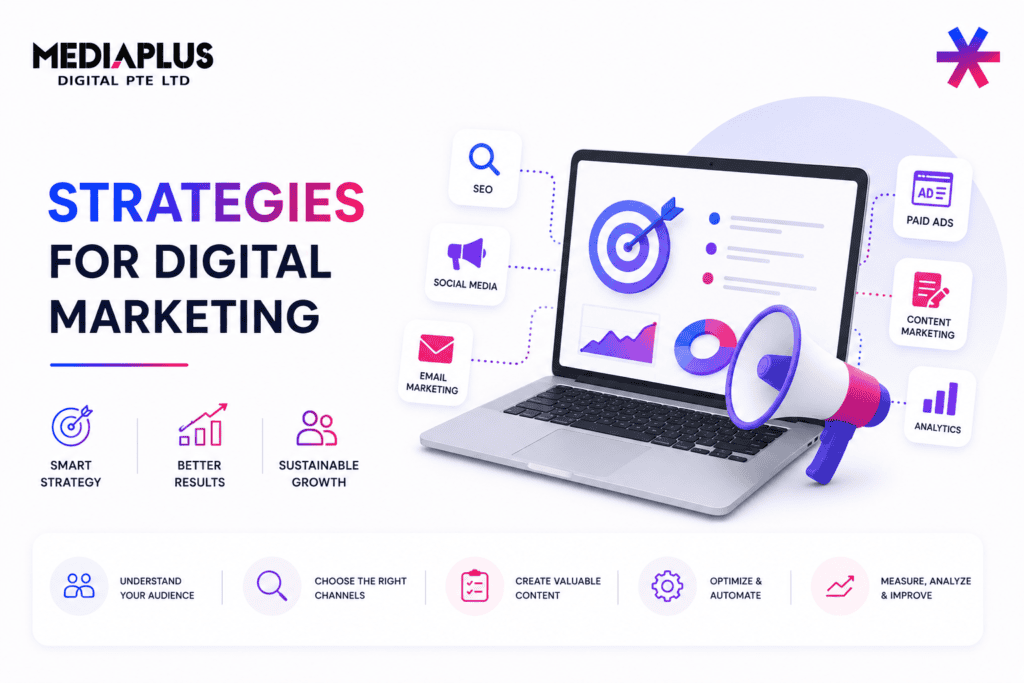
Most businesses in Australia are already spending money online. Fewer are spending it against a plan. The gap between those two states is where budgets quietly leak and where a competitor with half your product but twice your discipline takes the sale.
A digital marketing strategy closes that gap. This guide covers what a strategy actually is, why it matters, and an eight-step framework you can put to work this quarter. It is a build-and-execute guide, not a definition piece. If you want the fundamentals first, read our explainer on what is digital marketing, then come back here to build the plan.
What a digital marketing strategy is
A digital marketing strategy is a documented plan that connects your business goals to the online channels, budget and activities that will reach them. It answers four questions: who you are trying to reach, what you want them to do, where and how you will meet them, and how you will know it worked. A strategy is the reasoning. The campaigns, ads and posts are the output. Get the order wrong, and you end up running tactics with no scoreboard.
It helps to separate three terms that get used interchangeably. Marketing is the broad discipline of creating and communicating value, covered in our piece on what is marketing. Digital marketing is that discipline delivered through online channels. A digital marketing strategy is your specific plan for doing it.
Why you need one
The Australian market rewards planning because it is crowded and mature. DataReportal’s Digital 2026 Australia report counts 26.2 million internet users, about 97.1 percent of the population, and 21 million active social media users (DataReportal, February 2026). Almost everyone you want to reach is online, which means almost every competitor is trying to reach them too. Attention is the scarce resource, not access.
A written strategy earns its keep in three ways:
- It stops random-act marketing. Without a plan, spend follows whoever shouted loudest in the last meeting: a boosted post here, a trade-show banner there. Money moves, results do not.
- It makes budget defensible. When you can tie every dollar to a goal and a metric, budget conversations become evidence, not opinion.
- It compounds. SEO, content and email build value over months. A strategy keeps you investing in them long enough to pay off, rather than switching channels every time a campaign feels slow.
The rest of this article is the framework. Work through the eight steps in order the first time, then revisit them each quarter.
The 8-step digital marketing strategy framework
Step 1: Set SMART goals and KPIs
Start with the business outcome, not the marketing activity. “Get more Instagram followers” is an activity. “Generate 40 qualified leads a month at a cost per lead under 90 AUD” is a goal you can plan and measure against.
Use the SMART test. Every goal should be Specific, Measurable, Achievable, Relevant and Time-bound. Then attach one or two key performance indicators (KPIs) to each goal so you know what you are actually watching.
Keep the goal list short. Three to five business goals for the year is plenty. Everything downstream, from channel choice to budget, should trace back to one of them.
Step 2: Understand your audience and build personas
You cannot choose channels or write messages until you know who is on the other end. Build two or three buyer personas that capture your best customers: their role, the problem they are trying to solve, what triggers the purchase, and where they spend time online.
Pull this from real sources, not guesswork:
- Sales and support conversations (the questions that come up again and again)
- Your Google Analytics and search query data
- Reviews and comments, yours and competitors’
- A short customer survey if you have an email list
For each persona, note the buying trigger and the objection. A Melbourne cafe fit-out company selling to venue owners has a very different persona to one selling reusable cups to those same venues. Same city, different message, different channel.
Step 3: Audit your current channels and competitors
Before adding anything new, take stock of what you already run. List every active channel: website, Google Business Profile, email list, each social account, any paid campaigns. For each, record traffic, conversions and cost over the last 12 months. This is your baseline, and it usually reveals one or two channels quietly doing most of the work and several doing almost nothing.
Then look outward. In digital marketing your competitors’ activity is largely public. Check which keywords they rank for, what their ads look like, how often they post, and what offers they lead with. A quick SWOT (strengths, weaknesses, opportunities, threats) at the end turns all of this into a shortlist of gaps you can attack.
Step 4: Map the funnel
Buyers move through stages, and each stage needs a different job from your marketing. Mapping the funnel stops you from asking a first-time visitor to buy before they trust you, or ignoring a warm lead who is ready to act. This structure is often described as top, middle and bottom of funnel, which we break down in our guide to ToFu, MoFu and BoFu, and it pairs neatly with the classic AIDA marketing model.
Here is the funnel with the goal and content type at each stage:
|
Funnel stage |
Buyer mindset |
Your goal |
Content and offers |
|
Awareness |
“I have a problem” |
Get discovered |
Blog posts, short video, social content, SEO |
|
Consideration |
“What are my options?” |
Earn trust |
Guides, case studies, comparisons, email nurture |
|
Conversion |
“I’m ready to choose” |
Win the sale |
Landing pages, demos, quotes, retargeting ads |
|
Retention |
“Was this a good choice?” |
Keep and grow |
Onboarding email, loyalty offers, useful content |
Retention is the stage most small businesses skip, and it is usually the cheapest revenue you will ever earn. Selling again to an existing customer costs a fraction of acquiring a new one.
Step 5: Choose your channels
Now match channels to the funnel stages and personas you have defined. You do not need every channel. You need the two or three that reach your audience at the stages where you are weakest.
This table maps common channels to the job they do best:
|
Channel |
Primary funnel stage |
Best for |
Typical KPI |
|
SEO |
Awareness, consideration |
Long-term, intent-driven traffic |
Organic sessions, keyword rankings |
|
Content marketing |
Awareness, consideration |
Building trust and authority |
Time on page, assisted conversions |
|
Paid search (Google Ads) |
Consideration, conversion |
Capturing active demand |
Cost per lead, conversion rate |
|
Paid social |
Awareness, consideration |
Reaching new audiences by interest |
Cost per click, reach, leads |
|
Email marketing |
Consideration, retention |
Nurturing and repeat sales |
Open rate, click rate, revenue per send |
|
Organic social |
Awareness, retention |
Brand presence and community |
Engagement rate, follower growth |
A few channel notes for the Australian market. Search demand is high and competitive, so SEO is a long game worth starting early. When you need results faster or want to capture people already searching to buy, Google Ads puts you in front of active demand from day one. If the goal is a steady flow of enquiries rather than awareness, treat lead generation as the outcome and let it decide your channel mix. For campaigns judged purely on measurable return, a performance marketing approach ties spend directly to conversions.
Step 6: Set your budget and allocation
Budget follows strategy, not the other way around. A workable starting point for Australian small and medium businesses is to allocate marketing spend across three buckets:
- Always-on (roughly 50 to 60 percent): SEO, content and email that build value every month.
- Demand capture (roughly 25 to 35 percent): paid search and retargeting that convert people ready to act.
- Testing (roughly 10 to 15 percent): new channels, creative and audiences, ring-fenced so an experiment cannot blow the core plan.
Split each channel budget into media (the ad spend itself) and production (creative, landing pages, content). Underfunding production is a common mistake: a well-targeted ad still fails if it points at a weak page. Set your figures in AUD, review them monthly, and move money towards what the numbers reward.
Step 7: Build a content and campaign plan
This is where strategy becomes a calendar. Take your goals, personas and chosen channels, and turn them into scheduled activity for the next 90 days.
A simple plan includes:
- Content themes: three or four topic buckets tied to your personas’ questions and your funnel stages.
- A publishing cadence: how often you post, send and publish on each channel, set at a level you can sustain.
- Campaigns: time-bound pushes around a launch, season or offer, with a clear start, end and target.
- Owners and deadlines: who is responsible for each item, so the plan survives a busy week.
Anchor the calendar to real dates that matter in Australia, from EOFY in June to seasonal peaks in your industry. Awareness-stage content should outnumber hard-sell content; if every post is an ad, audiences tune out. For more on the top of the funnel, our guide to increasing brand awareness covers the tactics that fill it.
Step 8: Measure, report and optimise
A strategy without measurement is just a wish list. Set up tracking before you launch, not after, so you have clean data from day one. That means Google Analytics 4 with conversions defined, Google Search Console connected, and conversion tracking on every paid channel.
Report on a fixed rhythm. A one-page monthly dashboard covering the KPIs from Step 1 is worth more than a fifty-slide deck nobody reads. Then act on it: shift budget towards channels beating their target, fix or pause the ones missing it, and note what you learned so next quarter starts smarter.
Here is a starter KPI table by goal:
|
Business goal |
Primary KPI |
Supporting metrics |
Review cadence |
|
Grow qualified leads |
Cost per qualified lead |
Conversion rate, lead volume |
Weekly |
|
Increase online sales |
Return on ad spend (ROAS) |
Average order value, cart abandonment |
Weekly |
|
Build brand awareness |
Branded search volume |
Reach, engagement rate |
Monthly |
|
Improve retention |
Repeat purchase rate |
Email revenue, churn |
Monthly |
A worked example: a Melbourne SME
Picture Northside Plumbing, a family-run business in Brunswick serving Melbourne’s inner north. They want more high-value jobs (hot water systems and bathroom renovations) rather than one-off tap repairs.
- Goal (Step 1): 25 renovation and hot water enquiries a month at a cost per lead under 70 AUD, within six months.
- Audience (Step 2): homeowners aged 35 to 60 in inner-north postcodes, searching in a hurry when something breaks or planning a renovation over weeks.
- Audit (Step 3): the website ranks for the business name only, the Google Business Profile has 40 reviews (a genuine strength), and there is no email or paid activity.
- Funnel (Step 4): strong on conversion intent (people searching “emergency plumber Brunswick”), weak on consideration for planned renovation work.
- Channels (Step 5): Google Ads for urgent, high-intent searches; local SEO and review generation for long-term visibility; a handful of project case-study pages to win considered jobs.
- Budget (Step 6): 3,000 AUD a month to start, roughly 55 percent Google Ads, 30 percent SEO and content, 15 percent testing local social ads.
- Plan (Step 7): two case-study pages a month, a monthly email to past customers about maintenance, and always-on search ads for priority services.
- Measure (Step 8): weekly check on cost per lead and call tracking, monthly review of rankings and review count.
Nothing here is exotic. It works because every activity traces back to a specific goal and gets measured against it.
Common mistakes to avoid
- Chasing channels, not customers. Picking TikTok because it is popular, rather than because your buyers are there.
- No documented plan. A strategy in someone’s head cannot be shared, reviewed or improved.
- Measuring vanity metrics. Followers and impressions feel good but rarely pay wages. Track leads, sales and cost.
- Setting and forgetting. The plan is a living document. Markets, algorithms and competitors move, so review quarterly.
- Skipping retention. Pouring budget into acquisition while ignoring the customers you already have.
Frequently asked questions
What is the difference between a digital marketing strategy and a plan?
The strategy is the thinking: your goals, audience and the reasoning behind your channel choices. The plan is the execution: the calendar, campaigns and budgets that carry it out. You need both, and the strategy comes first.
How long does it take to see results?
It depends on the channel. Paid search can generate leads within days. SEO, content and email typically take three to six months to build momentum and longer to reach full value. A sound strategy runs fast and slow channels together so you get early wins while the compounding ones mature.
How much should an Australian small business spend on digital marketing?
There is no single figure, but many SMEs budget somewhere between 5 and 10 percent of revenue on marketing, with the digital share rising each year. More useful than a percentage is tying spend to a target cost per lead or return on ad spend, then scaling what hits the target.
Do I need to be on every social platform?
No. Being active and consistent on the two platforms where your audience actually spends time beats a thin presence spread across six. Choose based on your personas from Step 2.
How often should I review my strategy?
Check your KPIs monthly and review the wider strategy each quarter. Do a full rebuild once a year, or sooner if your market shifts sharply.
Can I build a digital marketing strategy myself?
Yes, and this framework is designed for exactly that. Many businesses run the early stages in-house, then bring in specialists for the channels that need depth, such as technical SEO or paid media management. If your goals and KPIs are clear from the first step, every later decision has a reference point.
Turn the framework into a working plan
A strategy on paper is a start. The results come from running it well, month after month, and adjusting as the numbers come in. If you would rather build and execute the plan with a team that does this every day, our digital marketing service covers strategy, channels and reporting for Australian businesses. Bring your goals and we will help you map the rest.