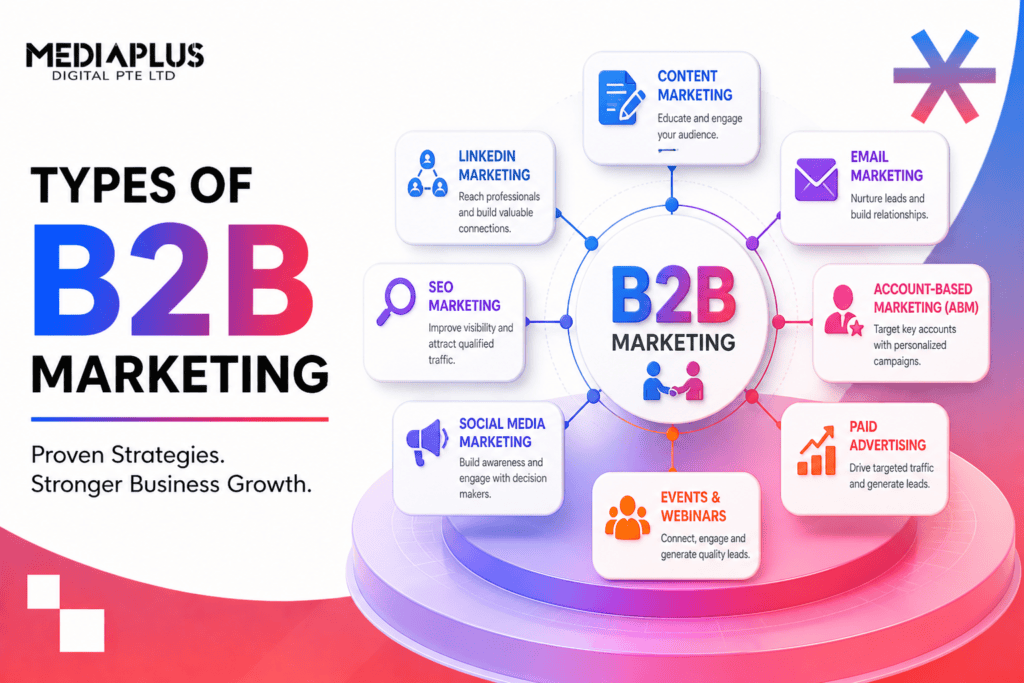
Quick answer: B2B marketing is usually grouped into content marketing, search and paid media, account based marketing, email, events, partner and channel marketing, outbound, and product led growth. Which ones suit you depends on two things: your average deal value and how many realistic customers exist in your market. Small market plus large deals favours ABM and events. Large market plus smaller deals favours search, content and product led.
Asking which type of B2B marketing is best is the wrong question. They solve different problems, and the right mix is determined by arithmetic rather than preference.
Two numbers decide it:
Your average deal value. This sets how much you can spend acquiring a customer.
The size of your addressable market. If there are 200 companies in Australia who could ever buy from you, running broad search campaigns is wasteful. If there are 200,000, personally researching each one is impossible.
Plot yourself on that grid before reading further.
|
Small market (under ~1,000 targets) |
Large market |
|
|
High deal value |
ABM, events, outbound, partner |
Search, content, ABM for top accounts |
|
Lower deal value |
Partner and channel, community |
Search, content, product led growth |
1. Content marketing
Publishing material that answers what buyers are researching, so you are present before they build a shortlist.
How it works in B2B. Long form guides, comparison pieces, benchmark data, templates and calculators. The best performing B2B content usually helps someone do their job rather than describing your product.
Timeline. Six to twelve months before meaningful results, then it compounds.
Best for: any B2B firm with a repeatable problem to explain and a cycle long enough for education to matter.
Where it fails: thin, frequent blog posts written for keyword volume rather than for the buying committee. Our guide to top, middle and bottom of funnel content covers matching content to buying stage.
2. Search marketing
Split into two mechanisms with different economics.
SEO builds pages targeting the problems you solve, the categories you compete in, and comparisons against incumbents. Slow, then durable.
Paid search buys visibility immediately on high intent terms. In B2B the click costs are high and the volumes small, which is acceptable when a deal is worth five figures.
Timeline. Paid search works in weeks. SEO takes six to twelve months.
Best for: markets where buyers actively search for a solution, which is most established categories.
Where it fails: genuinely new categories where nobody knows to search for you yet. There, demand has to be created rather than captured.
Our guides to SEO and SEO versus SEM cover the mechanics.
3. Account based marketing
Treat the market as a list of named target accounts rather than a funnel. Research each one, personalise the outreach and content, and coordinate sales and marketing around the same list.
How it works. Usually tiered: one to one for a handful of major accounts, one to few for clusters with shared characteristics, one to many for a broader named list with light personalisation.
Timeline. Three to twelve months per account, sometimes longer.
Best for: high deal values and a countable market. If your top 50 accounts represent most of your potential revenue, this is the highest return approach available.
Where it fails: low deal values, where the effort per account cannot be recovered.
4. Email marketing
The channel you own, which matters more in B2B than anywhere else because the cycle is long enough that renting attention for the full duration is expensive.
How it works. A database built from content downloads, events and enquiries, then nurtured with genuinely useful material until the buying trigger occurs.
Timeline. Immediate for an existing list, months to build one.
Best for: everyone. This is the closest thing to a universal B2B channel, and it underpins most of what our guide to lead generation covers.
Compliance note. The Spam Act 2003 requires consent, sender identification and a working unsubscribe on marketing emails to Australian recipients. Buying a list and emailing it is both ineffective and a compliance problem.
5. Event marketing
Trade shows, conferences, roundtables, webinars and your own hosted events.
How it works. Face to face still closes complex deals faster than anything digital. Small hosted roundtables with eight of the right people routinely outperform a stand at a large trade show.
Timeline. Immediate conversations, months to revenue.
Best for: high value, high trust, relationship driven sales. Strong in professional services, industrial and enterprise software.
Where it fails: when measured on badge scans rather than pipeline. Most trade show spend is justified by activity rather than outcome.
6. Partner and channel marketing
Selling through resellers, integrators, consultants or complementary vendors who already have the relationship.
How it works. You equip partners to sell on your behalf, with co-marketing, enablement material and margin.
Timeline. Three to twelve months to establish a productive partner, then leveraged.
Best for: products that need implementation or sit inside a wider stack. Also strong for entering a new market without local presence.
Where it fails: when partners are signed but never enabled. A signed partner who does not understand your product sells nothing.
7. Outbound
Direct, targeted contact: cold email, LinkedIn outreach, phone.
How it works. Best when tightly targeted and genuinely researched. Volume based outbound has become steadily less effective as inbox filtering and buyer fatigue increase.
Timeline. Immediate conversations, low conversion rates.
Best for: clearly definable target accounts, especially paired with ABM.
Compliance note. Australian recipients are covered by the Spam Act for email and the Do Not Call Register for phone. Business numbers have some exemptions, but the rules are narrower than most sales teams assume. Check before running a campaign.
8. Product led growth
The product itself does the acquisition, through a free tier, trial or freemium model.
How it works. Users adopt the tool individually, then expand into teams and eventually a commercial contract.
Timeline. Slow to build, then highly efficient.
Best for: software with fast time to value that an individual can adopt without procurement. The website carries most of the load here, so conversion rate optimisation matters more than in other models.
Where it fails: products requiring implementation, configuration or a security review before anyone can try them.
Comparing the eight
|
Type |
Speed to result |
Cost |
Scales |
Best deal size |
|
Content marketing |
Slow |
Moderate |
Yes |
Any |
|
Search: SEO |
Slow |
Moderate |
Yes |
Any |
|
Search: paid |
Fast |
High per click |
Yes |
Medium to high |
|
ABM |
Medium |
High per account |
No |
High |
|
|
Fast with a list |
Low |
Yes |
Any |
|
Events |
Medium |
High |
No |
High |
|
Partner and channel |
Medium |
Moderate |
Yes |
Medium to high |
|
Outbound |
Fast |
Moderate |
Partially |
Medium to high |
|
Product led |
Slow |
High upfront build |
Yes |
Low to medium |
How to choose your mix
Most Australian B2B companies should run three to four of these well rather than eight badly.
A workable default for a mid sized firm: search and content as the foundation, because they compound and capture existing demand. Email to hold the audience across a long cycle. Then one high touch channel, either ABM or events, depending on whether your buyers are easier to reach individually or in a room.
Add outbound only if you have a defined target list and someone accountable for it. Add partner marketing when you have a repeatable implementation. Add product led only if your product genuinely supports self service.
For the channel level detail on the digital side, see our guide to B2B digital marketing. Our roundup of B2B marketing agencies in Australia covers who does this locally.
Frequently asked questions
What are the four types of B2B marketing?
The shortest common grouping is content marketing, search and paid media, account based marketing, and events plus partnerships. The eight above break those down further, which is more useful when deciding where budget goes.
What is the difference between B2B and B2C marketing?
B2B involves a buying committee, a cycle of months rather than minutes, higher deal values, and decisions justified on business grounds. B2C is usually one person deciding quickly.
Which type of B2B marketing has the best ROI?
For most firms, search and email, because they capture existing demand and cost little per additional contact. ABM produces the highest return where deal values are large and the market is countable.
Is ABM worth it for a small business?
Only if deals are large enough to justify researching accounts individually. A useful test: if you cannot spend several thousand dollars pursuing one account and still profit, ABM is the wrong tool.
Do trade shows still work in B2B?
Yes, when measured on pipeline rather than badge scans, and often better as small hosted events than large stands. Face to face still shortens complex sales.
Where to start
Plot your deal value against your market size, then pick three approaches from the quadrant. Running three properly beats spreading budget across all eight.
Our digital marketing and performance marketing teams work with Australian B2B companies on building the mix. Contact us and we will look at your numbers and tell you which channels fit.