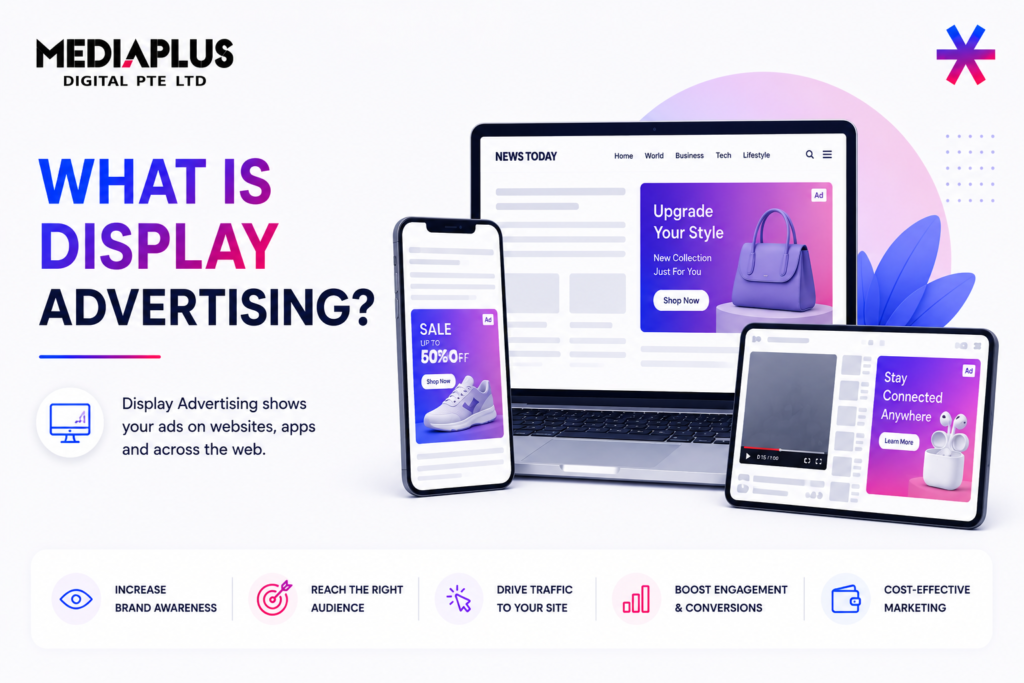
Display advertising is a form of online advertising that uses visual ads, such as banners, images, animations and video, placed on websites, apps and social platforms to reach people while they browse. Unlike a search ad that appears after someone types a query, a display ad finds the audience first, based on who they are, what they read and where they have already been.
If you have ever seen a banner running along the top of a news site, a product you looked at last week following you around the web, or a short video ad inside a mobile game, you have seen display advertising at work.
This guide covers how display advertising works, the main ad formats and targeting options, what it costs in Australia, where it falls short, and how to measure whether it is paying off.
How display advertising works
Behind almost every display ad sits a marketplace that buys and sells ad space in real time. The moment a page loads, an auction runs in the background, and the winning advertiser’s ad appears. This all happens in well under a second.
A few pieces make that possible.
- Ad networks. A network groups thousands of publisher websites and apps into one buying pool. Instead of negotiating with each site, you buy across the whole network at once.
- The Google Display Network (GDN). The largest of these, the GDN reaches roughly 90% of internet users worldwide across more than two million sites, apps and Google-owned properties like YouTube and Gmail. For most Australian advertisers, this is the entry point to display.
- Ad exchanges. These are open auction houses where ad space from many networks and publishers is bought and sold programmatically. They power the broader programmatic ecosystem beyond Google alone.
- Programmatic buying. This is the automated bidding that decides, in real time, which ad to show each person. Software evaluates the audience, the context and your bid, then places the ad. Our programmatic advertising services work across these exchanges rather than a single network.
You usually pay one of two ways:
- CPM (cost per mille): you pay per thousand impressions, whether or not anyone clicks. This suits awareness campaigns where the goal is being seen.
- CPC (cost per click): you pay only when someone clicks through to your site. This suits traffic and conversion goals.
Display leans more towards CPM than search does, because a large share of its value is visual exposure rather than the click itself.
Display ad formats
Display is not one ad type. It spans static images through to full video, and the format you choose shapes both cost and performance. Here are the formats worth knowing.
|
Format |
What it is |
Best for |
|
Static banner |
A single fixed image, sized to standard slots like 300×250 or 728×90 |
Simple, cheap reach and retargeting |
|
Animated banner |
An HTML5 banner with movement or rotating frames |
Drawing the eye without the weight of video |
|
Responsive display ad |
You supply headlines, images and logos; Google auto-assembles and resizes them to fit any slot |
Broad coverage with minimal design work |
|
Native ad |
An ad styled to match the look of the host page or feed |
Higher engagement, less banner fatigue |
|
Rich media |
Interactive units with expandable panels, forms or mini-games |
Deeper engagement and stronger recall |
|
Video |
Short in-stream or in-feed video, including YouTube placements |
Storytelling and brand building |
|
Interstitial |
A full-screen ad that appears at a natural break, common in apps |
High visibility, mostly mobile |
Responsive display ads are the practical default for most campaigns. You hand Google the raw parts and it builds combinations that fit almost any placement, which saves you producing dozens of fixed sizes. If you are running display through Google, our guide to the different types of Google Ads shows how these formats sit alongside search, shopping and video campaigns.
Targeting: who sees your ad
Targeting is where display earns its keep. Because you are not waiting for someone to search, you decide which audiences to put the ad in front of. The main options:
- Contextual targeting. Match ads to the content of the page. A running-shoe ad shows up on a marathon-training article. The ad is relevant to what the person is reading right now.
- Audience and interest targeting. Reach people grouped by longer-term interests or habits, such as frequent travellers or home-renovation researchers.
- Demographic targeting. Narrow by age, gender, parental status, household income and similar traits.
- Remarketing (retargeting). Show ads to people who already visited your site or app but did not convert. This is often the highest-returning slice of a display budget, because you are reminding warm prospects rather than introducing yourself to strangers.
- Placement targeting. Hand-pick the exact sites, apps, YouTube channels or pages you want to appear on, or exclude ones you do not.
- Lookalike (similar) audiences. Ask the platform to find new people who resemble your existing customers or converters, which extends reach while keeping quality reasonable.
Most strong campaigns stack a few of these rather than relying on one. A common structure is remarketing to recapture warm visitors, contextual and interest targeting to prospect for new ones, and placement exclusions to keep the ad off low-quality inventory.
The benefits of display advertising
- Scale of reach. Few channels can put your brand in front of as many people as quickly. The GDN alone spans most of the web.
- Brand awareness. Visual, repeated exposure builds recognition in a way text search ads cannot. When the person is finally ready to buy, you are already familiar.
- Remarketing. Display is the natural home for retargeting. It quietly keeps your brand in view across the sites people already visit.
- Visual branding. You control the imagery, colour and tone, so the ad carries your brand rather than blending into a list of blue links.
- Cost efficiency for exposure. On a cost-per-impression basis, display is one of the cheaper ways to be seen at volume. It fits naturally into a wider performance marketing mix that blends awareness with measurable response.
The limitations to plan around
Display is not a fix for everything, and pretending otherwise wastes budget. Know the trade-offs going in.
- Banner blindness. People have learned to tune out anything that looks like an ad, especially standard banners in the usual slots. Native and rich media formats help, but the instinct is real.
- Lower click-through rates. Display CTRs sit well below search. A cross-industry display CTR around 0.46% to 0.5% is normal, versus several per cent on search (Focus Digital, 2026). A sub-1% CTR is not a failure on display; it is the baseline.
- Click quality. Some display clicks are accidental, particularly on mobile where fingers catch banners near content. Judge display more on view-through impact and assisted conversions than on raw clicks.
- Placement risk. Broad networks can serve your ad next to content you would rather avoid. Exclusion lists and placement controls are not optional; they are ongoing maintenance.
None of these kill the channel. They simply mean display works best as an awareness and remarketing engine, supported by tight targeting and honest measurement, rather than as a direct-response workhorse on its own.
What display advertising costs in Australia
Australian pricing tracks global programmatic markets, so most published benchmarks are in USD. Treat the figures below as reference ranges and expect your own numbers to move with industry, format and audience.
|
Metric |
Typical range (global, USD) |
Notes |
|
GDN CPM |
US4 |
Standard Google Display inventory |
|
Private marketplace CPM |
US12 |
Curated premium publisher deals |
|
Programmatic guaranteed CPM |
US30 |
Reserved premium placements |
|
Display CTR |
~0.46% to 0.5% |
Cross-industry average, standard banners |
|
Rich media CTR |
~1.8% |
Roughly 4x standard banners |
Sources: Focus Digital (2026) display and programmatic CTR reports; Google Display Network benchmark data.
Two practical points. First, format matters more than most people expect: rich media and native units routinely earn several times the CTR of a plain banner, which changes the maths on production cost. Second, entry cost is low. You can run a meaningful display test on a few hundred dollars a month, though awareness campaigns generally need more scale to show their worth. For a fuller picture of local pricing across campaign types, see our breakdown of Google Ads costs in Australia.
How to measure display advertising
Because display earns much of its value before the click, the wrong metrics make a good campaign look bad. Track these:
- Impressions. How many times the ad was served. The raw reach figure.
- Viewable impressions. Impressions that actually appeared on screen long enough to be seen (the industry standard is 50% of the ad visible for at least one second). This is more honest than raw impressions.
- CTR. Clicks divided by impressions. Useful for comparing creatives and placements, but read it against display norms, not search norms.
- View-through conversions. Conversions from people who saw the ad, did not click, and came back later to convert. This is the metric that captures display’s real influence, and skipping it undervalues the whole channel.
- CPM and CPC. Your cost efficiency for exposure and for clicks respectively.
- Assisted conversions. How often display sat somewhere in the path to a sale, even if another channel closed it.
A campaign that looks weak on CTR alone can look strong once view-through and assisted conversions are in the picture. Set the measurement up before launch so you are not guessing later. Our Google Ads optimisation checklist walks through the tracking and account settings worth confirming before you spend.
Display advertising vs search advertising
The quickest way to separate them: search advertising captures existing demand, display advertising creates and nurtures it.
Someone typing “emergency plumber Melbourne” into Google already wants the service. A search ad meets that intent at the moment it exists. Display works earlier and later in the journey, building awareness before demand forms and staying visible through remarketing after a visit. Search tends to convert harder per click; display tends to reach wider and cost less per impression. Most mature accounts run both, with search catching demand and display feeding it.
For a full side-by-side on budgets, intent and when to use each, read our companion guide, search ads vs display ads.
Frequently asked questions
Is display advertising the same as banner advertising?
Banners are one part of display, not the whole thing. Display also covers native ads, rich media, video and interstitials. Banner is the oldest and most common format, which is why the terms often get used interchangeably.
Does display advertising actually work?
Yes, when you judge it on the right goals. It is strong for awareness and remarketing and weaker as a standalone direct-response channel. Measured on view-through and assisted conversions rather than clicks alone, well-run display earns its place.
Why is my display CTR so low?
A display CTR below 1% is normal. Cross-industry averages sit near 0.46% to 0.5% (Focus Digital, 2026). Rather than chasing clicks, look at viewability, view-through conversions and whether your targeting and placements are tight.
What is the difference between display and programmatic advertising?
Display describes the ad format (visual ads on sites and apps). Programmatic describes the buying method (automated, real-time auctions). Most display today is bought programmatically, but you can also buy display directly from a publisher, and programmatic buys formats beyond display, such as video and audio.
How much should I budget for display in Australia?
You can start testing on a few hundred dollars a month, but awareness campaigns usually need more scale to matter. Budget to your goal: remarketing can run lean and efficient, while broad prospecting needs enough spend to reach a useful audience size.
What is remarketing and why does it matter for display?
Remarketing shows ads to people who already visited your site but did not convert. It is often the best-returning part of a display budget because you are re-engaging warm prospects instead of finding cold ones, and display is the natural channel for it.
Which is better for me, search or display?
If you need to capture people actively looking for you now, start with search. If you need to build awareness or bring back past visitors, add display. Most businesses benefit from both once the basics are working.
Getting display advertising right
Display advertising rewards patience and precise targeting more than big creative swings. Get the audiences, exclusions and measurement right, treat it as an awareness and remarketing engine alongside search, and it becomes one of the more cost-effective ways to keep your brand in front of the right people.
If you want a hand setting it up, MediaPlus Digital plans and runs display campaigns for Australian businesses through both the Google Display Network and broader programmatic channels. Have a look at our approach or get in touch for a straight assessment of whether display suits your goals.