Most people have seen programmatic advertising without knowing it. The banner that follows you around after you browsed a pair of runners, the video ad on a catch-up TV app, the billboard near the tram stop that changed message when it started raining. All of that can be bought and served programmatically.
This guide walks through the main types of programmatic advertising with a concrete example for each, a formats table you can scan in ten seconds, a set of documented brand campaigns with sources, and a few illustrative Australian small-business use cases. It finishes with how to measure results and how to get started.
What programmatic advertising actually means
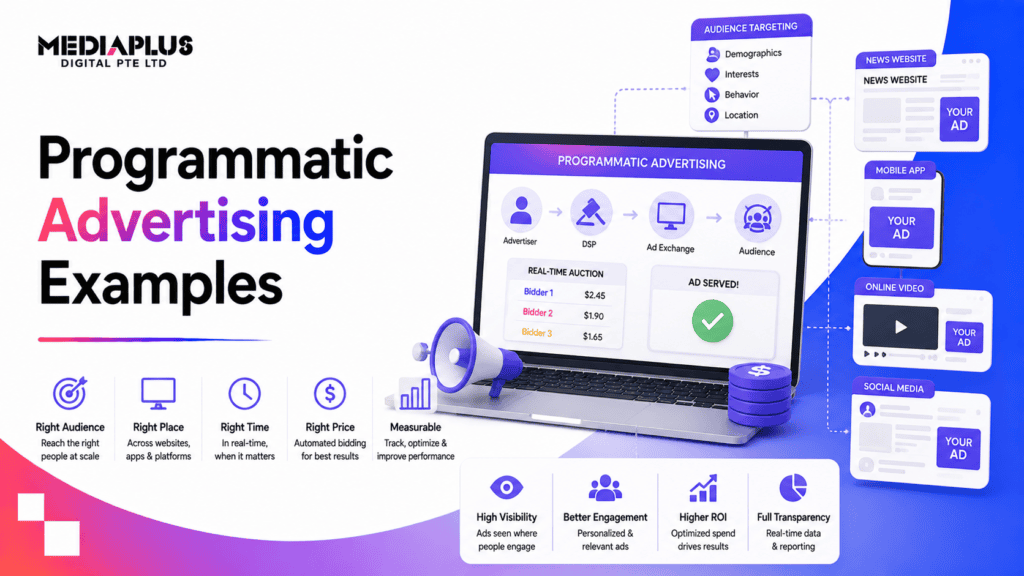
Programmatic advertising is the automated buying and selling of ad space. Instead of a human negotiating each placement, software decides which ad to show which person, on which site or app, and at what price, usually in the fraction of a second while a page loads.
A few pieces make it work:
- DSP (demand-side platform): the tool advertisers use to buy inventory and set targeting.
- SSP (supply-side platform): the tool publishers use to sell their ad space.
- Ad exchange: the marketplace that connects the two.
- RTB (real-time bidding): the live auction that runs for each impression.
- DMP or audience platform: the data layer that groups people into segments.
If you want the underlying mechanics of banners and placements, our explainer on what display advertising is covers the format basics. Programmatic sits on top of that, adding the automated buying and audience data.
The short version: you set who you want to reach and what an impression is worth, and the system buys the closest match it can find, one auction at a time.
The main types of programmatic advertising, with examples
1. Real-time bidding display
This is the classic case. Banner and rich-media ads bought impression by impression through an open auction.
Example: a Melbourne homewares retailer wants to reach people who have recently looked at bedding and homewares content. Its DSP bids on matching impressions across thousands of sites, paying more for a strong match near a purchase moment and less for a weak one. Nobody manually books any of it.
2. Programmatic direct and private marketplaces (PMP)
Not all programmatic runs in the open auction. With programmatic guaranteed and private marketplace deals, a buyer arranges fixed inventory or an invite-only auction with a specific publisher, keeping the automation but adding control over where ads appear.
Example: a challenger bank negotiates a programmatic guaranteed deal with a finance publisher so its ads run against personal-finance articles at an agreed rate, with brand-safe placement locked in.
3. Retargeting and remarketing
Retargeting shows ads to people who already visited your site or app but did not convert. It is usually the highest-intent audience you can buy.
Example: a Sydney online store serves a reminder ad to shoppers who added an item to cart and left. Nestle and GroupM ran a documented version of this, building a remarketing audience of people who had clicked a Sponsored Products ad but not yet bought, according to Amazon Ads.
4. Programmatic video, CTV and BVOD
Video inventory bought programmatically, including connected TV (CTV) and broadcast video on demand (BVOD) such as catch-up apps on a smart TV. This is one of the faster-growing areas of the market in Australia.
Example: a meal-kit brand runs 15-second ads inside a streaming app, targeting households in metro postcodes and capping how many times each household sees the spot.
5. Programmatic audio
Audio ads served into music streaming, podcasts and digital radio, bought the same automated way and targeted by listener data rather than a station’s rough demographic.
Example: a fitness studio chain places audio ads in workout playlists during weekday mornings, aimed at listeners within a few kilometres of each location.
6. Digital out-of-home (DOOH)
Billboards, transit screens and retail displays bought programmatically. Modern DOOH can change creative based on triggers such as time of day, weather or live data.
Example: a sunscreen brand sets its DOOH creative to appear only when the UV index in that city passes a set threshold, so the ad shows on the days it matters most.
7. Native advertising
Ads that match the look and feel of the content around them, such as recommended-article units, bought through programmatic native exchanges.
Example: a healthtech company promotes a helpful article through native placements that sit inside editorial feeds rather than as a boxed banner.
8. Dynamic creative optimisation (DCO)
DCO builds the ad on the fly from a template, swapping images, copy, product and offer to fit each viewer. It is less a channel than a layer that can run across display, video, native and social.
Example: a laptop retailer runs one ad template that automatically features the exact model a shopper viewed, and highlights the spec that person spent longest reading, such as battery life or storage.
Programmatic formats at a glance
|
Format |
Where it appears |
Bought as |
Quick example |
|
RTB display |
Websites and apps |
Open auction |
Homewares retailer bidding on bedding-content impressions |
|
Programmatic direct / PMP |
Premium publishers |
Guaranteed or invite auction |
Bank locking finance-site placement at a fixed rate |
|
Retargeting |
Sites and apps |
Open auction, retargeted audience |
Store reminding cart abandoners |
|
Video / CTV / BVOD |
Streaming and catch-up TV |
Auction or guaranteed |
Meal-kit brand running 15s CTV spots by postcode |
|
Audio |
Music, podcasts, digital radio |
Auction or guaranteed |
Fitness chain in weekday workout playlists |
|
DOOH |
Billboards, transit, retail screens |
Auction or guaranteed |
Sunscreen ad triggered by UV index |
|
Native |
In-feed and recommendation units |
Native exchange |
Healthtech promoting an article in editorial feeds |
|
DCO (creative layer) |
Across the formats above |
Applied to any buy |
Laptop ad auto-featuring the viewed model |
Documented brand campaigns worth knowing
These are real campaigns with published detail. Where a source reports figures, they are attributed. Treat them as illustrations of what the channel can do, not as promises of any particular result.
The Economist: retargeting the intellectually curious. The Economist ran a programmatic display campaign that served provocative one-line ads to readers whose behaviour suggested curiosity but low engagement. The publisher reported 650,000 new prospects, 3.6 million people taking action and a return of about 10 to 1 on a media budget near 1.2 million pounds, per Econsultancy and GWI.
Amanda Foundation: “Digital Pawprint”. The animal-rescue charity, with agency Saatchi and Saatchi, used behavioural and geographic data to match shelter animals to likely adopters, so someone who liked small dogs saw a chihuahua and an active hiker saw a bigger dog. It is a clean example of dynamic creative doing the targeting work. Coverage via Digital Marketing Institute.
Missing People: “Child Rescue Alert” on programmatic DOOH. The UK charity moved its missing-child appeals to programmatic digital out-of-home, using live registration and location data to push alerts into the areas that needed coverage. Marketing Week reported that 44,000 people responded in one month, against 10,000 for a concurrent print and PR appeal, and that the volunteer “local heroes” network grew by roughly a third. See Marketing Week and campaign builder Grand Visual.
Google Search app: programmatic at brand scale. Google promoted its own Search app largely through programmatic display and reported reaching about 30 per cent more people, roughly three times more often, at a lower cost per thousand impressions, as summarised by Pathlabs.
IHG: winning back the direct booking. Intercontinental Hotels Group used programmatic to show its own direct prices to people comparing hotels on third-party booking sites, customising the message by location, dates and history to pull bookings back to its own channel, per Digital Marketing Institute.
The pattern across all of them: data decides who sees the ad, and the creative changes to fit that person.
Illustrative Australian SME use cases
Most Australian small and mid-sized businesses will not run a million-dollar campaign. Programmatic still fits at a smaller scale. These examples are illustrative rather than reports of specific clients.
- A suburban dental clinic runs geo-fenced display and audio within a 5 km radius, retargeting people who visited its booking page but did not finish. Frequency is capped so nobody gets worn out.
- An ecommerce activewear brand uses DCO to show returning visitors the exact product they viewed, plus free-shipping messaging once the cart passes a threshold.
- A regional tourism operator buys CTV and BVOD against travel content in Melbourne and Sydney postcodes ahead of school holidays, then retargets site visitors with display in the fortnight before they typically book.
- A B2B software company combines programmatic native and display against industry publications, feeding leads into a longer nurture. This is where programmatic overlaps with broader performance marketing, since the ad click is only the first step.
Programmatic and search advertising often run side by side rather than as either/or. If you are weighing the two, our comparison of search ads versus display ads is a useful starting point, and the overview of the types of Google Ads shows where display and video sit within a wider account.
How to measure programmatic advertising
The metric that matters depends on the job the campaign is doing. A common mistake is judging an awareness buy by last-click sales.
For awareness and reach:
- Impressions and unique reach
- CPM (cost per thousand impressions)
- Video completion rate and viewability
- Brand-lift or recall, where you can run a study
For consideration and response:
- Click-through rate, with caution, since clicks flatter display
- Cost per click and cost per landing-page visit
- Engaged sessions and pages per session
For conversions:
- Conversions and cost per acquisition
- Return on ad spend (ROAS)
- View-through conversions, kept separate from click-through so you can see each
Two habits keep the numbers honest. Watch viewability and invalid-traffic rates, because you only want to pay for ads a real person could actually see. And set a sensible attribution window that matches how long your customers take to decide, so a considered purchase is not measured on the same clock as an impulse buy.
How to get started
You do not need a large budget to begin, but you do need a few things in place.
- Set one clear objective. Awareness, consideration or conversion. It decides your format, your targeting and your success metric.
- Sort out tracking first. Conversion tags, server-side or consent-mode setup, and clean audience lists. Programmatic without measurement is just spending.
- Prepare audiences. First-party lists (email subscribers, past buyers, site visitors) tend to outperform broad third-party segments, and they are more durable as third-party cookies fade.
- Build creative that can flex. Several sizes and a few variants at minimum, so DCO and testing have something to work with.
- Start narrow, then widen. Begin with retargeting and tight geo-targeting where intent is highest, prove the funnel, then scale into prospecting.
- Set guardrails. Frequency caps, brand-safety and inventory filters, and a domain block list so budget does not leak to low-quality placements.
Budget planning tends to be the sticking point for smaller advertisers. Our breakdown of Google Ads costs in Australia gives a reasonable frame of reference for CPMs and typical spend, since much of programmatic runs through or alongside Google’s stack. For the display side of the buy specifically, see our page on Google display ads.
Frequently asked questions
Is programmatic advertising the same as Google Ads?
Not quite. Google Ads includes programmatic-style buying (the Display Network and Demand Gen run on automated auctions), but true programmatic spans many exchanges and channels beyond Google, bought through a DSP. Google is one large slice of the market, not the whole of it.
What is the difference between programmatic and display advertising?
Display is a format (the banner or rich-media unit). Programmatic is a buying method (automated, auction-based). You can buy display programmatically, and you can also buy video, audio, native and DOOH the same way.
How much does programmatic advertising cost?
It is priced mostly on CPM, and the rate varies by channel and audience. Premium CTV and tightly targeted segments cost more per thousand than broad open-auction display. Many DSPs and managed services have minimum spends, so it suits businesses that can commit a steady monthly budget rather than a one-off burst.
Does programmatic still work without third-party cookies?
Yes, and the shift is well under way. First-party data, contextual targeting (matching ads to page content rather than the individual), and channels like CTV, audio and DOOH that never relied on cookies are all growing. Campaigns built on your own audience data are the most future-proof.
Is programmatic advertising suitable for small businesses?
It can be, particularly for local geo-targeting and retargeting where a modest budget reaches the right people rather than everyone. The main requirements are proper tracking and enough budget to gather meaningful data, so very small once-off campaigns often struggle to learn.
How do I know if a programmatic campaign is working?
Match the metric to the objective. Judge awareness by reach, viewability and brand lift; judge response by cost per landing-page visit and engaged sessions; judge conversion campaigns by cost per acquisition and ROAS. Keep view-through and click-through conversions separate so you can see what each is really doing.
What is dynamic creative optimisation?
DCO assembles the ad from a template in real time, swapping images, copy, product and offer to fit each viewer. It is what lets one campaign show a returning shopper the exact product they looked at, rather than a single generic banner for everyone.
Where to go from here
Programmatic rewards planning more than budget. Clear objective, clean tracking, good first-party audiences and creative that can flex will do more than a big spend pointed in a vague direction.
If you want a second set of eyes on a plan, MediaPlus Digital runs programmatic advertising services for Australian businesses, and can fold it into a wider paid advertising approach so search, display and programmatic pull in the same direction. Reach out for a look at where it fits for you.