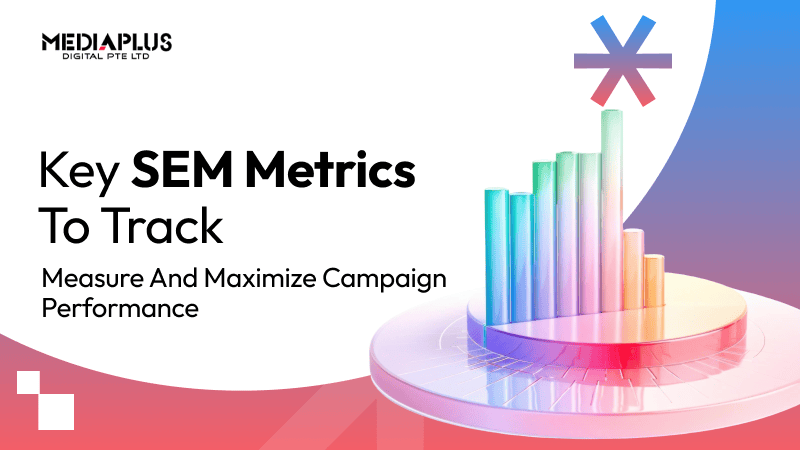
Search Engine Marketing (SEM) is no longer just about running ads or ranking keywords. It’s about how SEO and PPC work together as one system to drive measurable business growth.
To do that effectively, you need more than surface-level data. You need to understand the right SEM metrics in depth, what they actually mean, and how to improve them.
What Are SEM Metrics?
SEM metrics are quantifiable indicators that measure the performance of both:
-
Organic search (SEO)
-
Paid search (PPC)
Instead of analyzing these channels separately, SEM metrics allow you to evaluate:
-
Traffic quality
-
User behavior
-
Cost efficiency
-
Revenue impact
This holistic view is what turns marketing from guesswork into strategy.
Why SEM Metrics Are Critical
If you’re running campaigns without properly tracking SEM metrics, you’re missing key insights like:
-
Which keywords actually drive revenue
-
Where budget is being wasted
-
Why users click but don’t convert
-
How SEO supports paid campaigns (and vice versa)
Strong SEM tracking helps you:
-
Make faster, data-driven decisions
-
Allocate budget more efficiently
-
Scale what works and cut what doesn’t
8 Essential SEM Metrics (Deep Dive)
Below are the most important SEM metrics, explained in detail with practical insights.
1. Click-Through Rate (CTR)
Definition: CTR is the percentage of users who click on your ad or search result after seeing it.
Formula: CTR = (Clicks ÷ Impressions) × 100
Why CTR Matters
CTR is one of the strongest indicators of relevance.
-
In PPC, a high CTR signals to Google that your ad matches user intent
-
In SEO, it shows how attractive your title and meta description are
A strong CTR can lead to:
-
Better ad rankings
-
Lower CPC
-
More organic visibility
What a “Good” CTR Looks Like
-
Search Ads: ~3% to 8% (can be higher for branded terms)
-
Display Ads: ~0.5% to 1.5%
-
Organic Results: varies by ranking position
How to Improve CTR
-
Align messaging with search intent
-
Use emotional or curiosity-driven headlines
-
Add numbers, benefits, or urgency (e.g. “Save 30% Today”)
-
Test multiple ad variations (A/B testing)
2. Cost Per Click (CPC)
Definition: The average amount you pay for each click in a PPC campaign.
Formula: CPC = Total Ad Spend ÷ Total Clicks
Why CPC Matters
CPC directly impacts your budget efficiency.
-
Lower CPC = more traffic for the same budget
-
High CPC = expensive campaigns that require strong conversion rates to stay profitable
What Influences CPC
-
Competition for keywords
-
Quality Score
-
Industry (finance and legal tend to be higher)
-
Bid strategy
How to Reduce CPC
-
Improve Quality Score (huge impact)
-
Focus on long-tail keywords (lower competition)
-
Use negative keywords to filter irrelevant traffic
-
Optimize ad relevance and landing page experience
3. Conversion Rate (CVR)
Definition: The percentage of users who complete a desired action after clicking.
Formula: CVR = (Conversions ÷ Clicks) × 100
Why CVR Matters
This is where traffic turns into actual business results.
You can have:
-
High CTR
-
Low CPC
But if CVR is low, your campaigns still fail.
What Counts as a Conversion
-
Purchases
-
Form submissions
-
Calls
-
App installs
How to Improve CVR
-
Ensure strong message match (ad → landing page)
-
Simplify forms and reduce friction
-
Use clear and compelling CTAs
-
Add trust signals (reviews, testimonials, guarantees)
-
Optimize page speed and mobile experience
4. Quality Score (QS)
Definition: A Google Ads metric (1–10) that measures the quality and relevance of your ads.
Key Components
-
Expected CTR
-
Ad relevance
-
Landing page experience
Why Quality Score Matters
Quality Score directly affects:
-
CPC (higher score = lower cost)
-
Ad position
-
Overall campaign efficiency
Even a small improvement in QS can significantly reduce costs.
How to Improve Quality Score
-
Use tightly themed ad groups (SKAG or similar structure)
-
Include keywords in headlines and descriptions
-
Improve landing page load speed and usability
-
Ensure content matches search intent
5. Return on Ad Spend (ROAS)
Definition: The revenue generated for every dollar spent on advertising.
Formula: ROAS = Revenue ÷ Ad Spend
Why ROAS Matters
ROAS is the ultimate profitability metric for PPC.
Example:
-
Spend $1,000 → Generate $4,000
-
ROAS = 4.0 (or 400%)
What Is a Good ROAS?
Depends on your margins, but generally:
-
2x–3x = acceptable
-
4x+ = strong
-
5x+ = excellent
How to Improve ROAS
-
Focus on high-intent keywords
-
Use remarketing to capture lost users
-
Optimize product or service pricing strategy
-
Improve conversion rate
6. Average Position (SEO Ranking)
Definition: The average ranking position of your pages in search results.
Why It Matters
Higher rankings lead to:
-
More visibility
-
More clicks
-
More organic traffic
But ranking alone is not enough. It must align with intent and conversion.
How to Improve Rankings
-
Create high-quality, original content
-
Optimize on-page SEO (titles, headings, internal links)
-
Build high-authority backlinks
-
Regularly update content
7. Impression Share
Definition: The percentage of impressions your ads receive compared to total possible impressions.
Why It Matters
Low impression share means:
-
You’re missing potential traffic
-
Competitors are capturing your audience
Types of Lost Impression Share
-
Budget lost (not enough spend)
-
Rank lost (low ad quality or bids)
How to Improve It
-
Increase campaign budget
-
Improve Quality Score
-
Adjust bidding strategy
8. Cost Per Conversion (CPA)
Definition: The cost required to generate one conversion.
Formula: CPA = Total Ad Spend ÷ Conversions
Why CPA Matters
CPA tells you if your campaigns are financially sustainable.
Even if traffic looks good, high CPA can kill profitability.
How to Lower CPA
-
Improve conversion rate
-
Refine targeting (audience + keywords)
-
Use negative keywords
-
Optimize landing pages
How to Turn Metrics into Growth
Tracking metrics is just the first step. Real growth comes from acting on those insights consistently.
To improve SEM performance in a meaningful way, businesses need to combine data tracking with execution-focused services such as:
-
Landing page optimisation to improve conversion rate (CVR)
-
Google Ads service to optimise bids, targeting, and overall campaign performance
-
PPC advertising service to manage cost efficiency and scale paid traffic effectively
-
Performance marketing to maximise return on ad spend (ROAS) and scale high-performing campaigns
A provider like Mediaplus Digital Australia typically integrates these services into a unified strategy. This allows businesses not only to monitor SEM metrics, but also to actively optimise campaigns, reduce wasted spend, and drive sustainable growth over time.
Final Thoughts
SEM in 2026 is more integrated than ever.
SEO and PPC are no longer separate channels. They are two sides of the same growth engine.
If you focus on the right metrics and understand them deeply, you’ll be able to:
-
Identify what actually drives revenue
-
Optimize campaigns with confidence
-
Scale performance sustainably
Start with these eight SEM metrics, go deeper into each one, and continuously refine your strategy. That’s how you turn data into real business results.