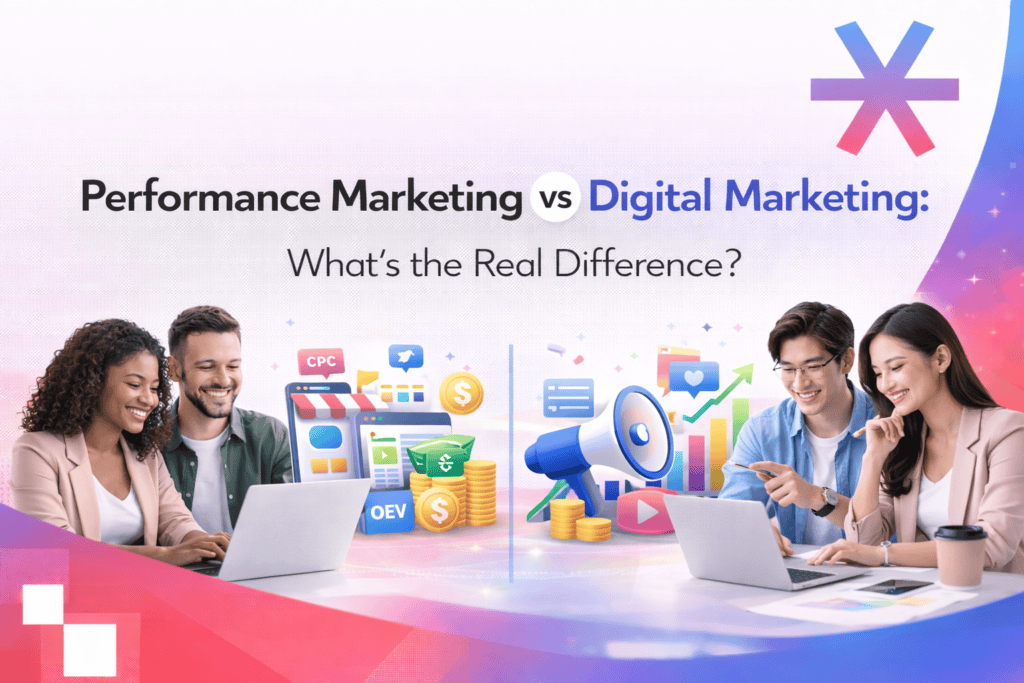
Performance marketing and digital marketing are often used interchangeably, but they are not the same thing.
Digital marketing is the broad umbrella.
Performance marketing is a results-focused subset within that umbrella.
Understanding the difference helps you decide where to invest your budget, how to measure success, and how to structure your growth strategy.
What Is Digital Marketing?
Digital marketing refers to all marketing activities that happen online.
It focuses on building brand presence, attracting audiences, and nurturing customer relationships across digital channels. The emphasis is on where marketing happens rather than how payment is structured.
Digital marketing can include:
- Search engine optimization
- Content marketing
- Email marketing
- Social media marketing
- Influencer collaborations
- Affiliate partnerships
- Online display advertising
- Video marketing
The goals of digital marketing often include:
- Increasing brand awareness
- Driving website traffic
- Building trust and authority
- Growing audience engagement
- Supporting long-term customer retention
Some digital marketing tactics deliver immediate results. Others compound over time.
What Is Performance Marketing?
Performance marketing is a strategy within digital marketing that focuses strictly on measurable outcomes.
Instead of paying for exposure, businesses pay only when a specific action occurs.
Those actions may include:
- A click
- A lead submission
- A sale
- An app install
- A completed signup
Common performance models include:
- Cost Per Click (CPC)
- Cost Per Lead (CPL)
- Cost Per Acquisition (CPA)
- Return on Ad Spend (ROAS)
The defining feature of performance marketing is accountability. Every dollar spent is tied directly to a trackable result.
Key Differences Between Performance Marketing and Digital Marketing
Although they overlap, their focus and structure differ in important ways.
1. Scope
Digital marketing is the full ecosystem of online marketing strategies.
Performance marketing is one approach within that ecosystem, focused specifically on measurable outcomes.
All performance marketing is digital marketing.
Not all digital marketing is performance marketing.
2. Goal Orientation
Performance marketing prioritizes immediate, measurable actions. It is designed to generate conversions quickly and efficiently.
Digital marketing often focuses on broader goals such as brand positioning, storytelling, and long-term audience development. Conversions may be a goal, but they are not always immediate.
3. Cost Structure
In performance marketing, advertisers typically pay only when a defined action happens.
In digital marketing, investment may be upfront. For example, SEO requires content creation and technical optimization before results appear. Social media branding campaigns may focus on engagement without immediate revenue attribution.
4. Metrics Used
Performance marketing relies heavily on revenue-linked metrics such as:
- Cost Per Acquisition
- Return on Ad Spend
- Conversion Rate
- Customer Lifetime Value
Digital marketing tracks broader engagement indicators such as:
- Website traffic
- Bounce rate
- Time on site
- Email open rate
- Social engagement
Performance marketing measures direct response.
Digital marketing measures overall digital presence and engagement.
Where They Overlap
Performance marketing and digital marketing are not competitors. They are complementary.
For example:
Paid search campaigns fall under performance marketing, but they are also part of digital marketing.
SEO is digital marketing, but it can support performance campaigns by improving landing page quality and authority.
Email marketing can be brand-focused or performance-driven depending on how it is structured.
The most effective strategies combine both approaches.
When to Use Performance Marketing
Performance marketing is ideal when:
- You need fast lead generation
- You want predictable acquisition costs
- You are launching a new product
- You are scaling e-commerce revenue
- You need measurable ROI
Because results are trackable, performance marketing works well for businesses that prioritize efficiency and accountability.
When to Focus on Digital Marketing
Digital marketing is critical when:
- You are building long-term brand authority
- You want sustainable organic traffic
- You aim to nurture customer relationships
- You are entering a competitive market and need positioning
Digital marketing builds the foundation that makes performance marketing more effective over time.
Why Combining Both Creates Stronger Results
Relying only on performance marketing can create short-term gains but long-term dependency on paid traffic.
Relying only on digital marketing can delay measurable revenue growth.
A balanced approach might look like this:
- SEO builds organic visibility and reduces paid dependency over time.
- Content marketing strengthens trust and authority.
- Paid search captures high-intent users immediately.
- Paid social drives targeted acquisition.
- Performance optimization improves conversion efficiency.
When integrated properly, digital marketing builds the ecosystem and performance marketing drives the engine.
Performance Marketing vs Digital Marketing: The Bottom Line
Digital marketing is the broader strategy of promoting a brand online across multiple channels.
Performance marketing is a data-driven subset focused on paying for specific, measurable results.
One builds long-term brand equity.
The other accelerates measurable growth.
For Australian businesses aiming to balance both approaches, MediaPlus Digital Australia supports growth through:
- Strategic performance marketing service focused on measurable ROI
- Advanced Google Ads service and broader PPC advertising service
- Conversion-driven landing page development service
- Comprehensive digital marketing service aligned with omnichannel strategy
- Long-term SEO service to strengthen sustainable organic visibility
Performance marketing drives immediate results.
Digital marketing builds long-term strength.
The strongest growth strategies use both in alignment, not in isolation.