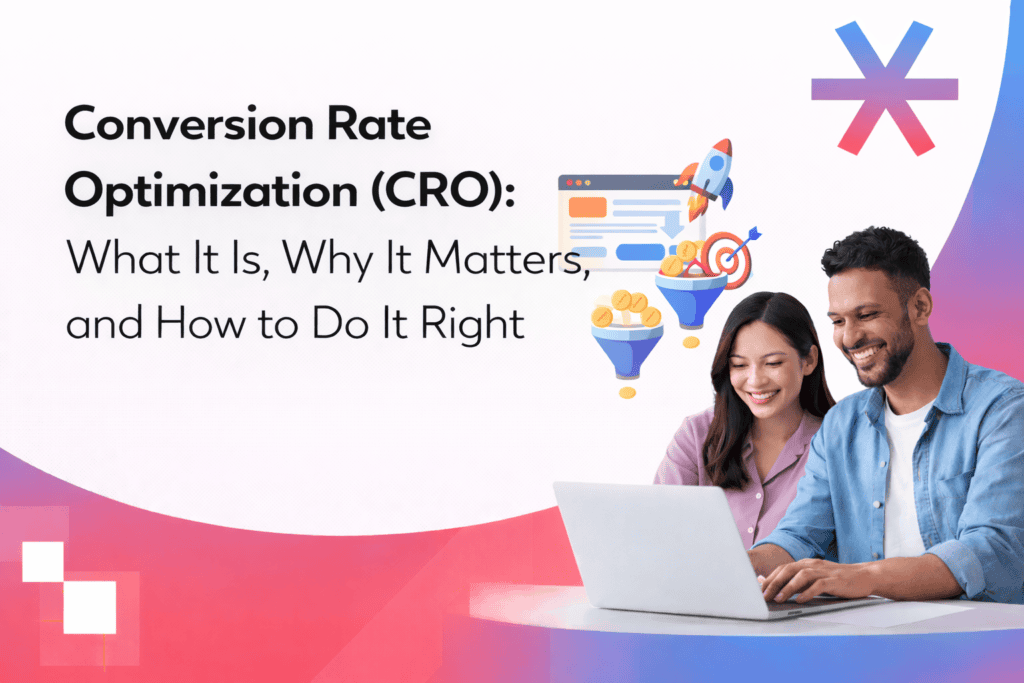
Your website does not fail because it lacks traffic. In most cases, it fails because visitors do not take action.
Conversion Rate Optimization, often called CRO, focuses on fixing that problem. Instead of chasing more clicks, CRO improves how effectively your website turns existing visitors into leads, customers, and revenue.
In an increasingly competitive digital landscape, CRO is no longer a nice-to-have. It is a core growth discipline for businesses that want better performance from their marketing spend.
What Is Conversion Rate Optimization?
Conversion Rate Optimization is the process of increasing the percentage of website or app users who complete a desired action.
That action might include submitting a contact form, making a purchase, booking a consultation, or signing up for a newsletter. CRO works by analysing user behaviour, identifying friction points, and testing improvements that make it easier for users to convert.
CRO is not about guessing. It relies on data, experimentation, and continuous learning.
Why Conversion Rate Optimization Matters
Traffic alone does not guarantee results. Without CRO, even high-quality traffic can underperform.
A strong CRO strategy helps businesses:
-
Increase revenue per visitor
-
Reduce customer acquisition costs
-
Improve lead quality
-
Get more value from existing traffic
-
Scale growth without proportionally increasing ad spend
For businesses investing in SEO, paid media, or social campaigns, CRO ensures those efforts translate into measurable outcomes.
What Counts as a Conversion?
A conversion depends on your business model and objectives. There is no universal definition.
Common conversion goals include:
-
eCommerce websites: Product purchases, add-to-cart actions, checkout completions
-
B2B and service businesses: Lead form submissions, demo bookings, consultation requests
-
Media and content platforms: Newsletter sign-ups, account registrations, content downloads
-
Travel and hospitality: Bookings, enquiries, upsell purchases
Clear conversion definitions are essential before optimisation begins.
Key Elements of an Effective CRO Strategy
CRO succeeds when it is structured and evidence-based.
An effective conversion optimisation strategy typically includes:
-
User research: Understanding user intent, objections, and motivations
-
Website analytics: Analysing traffic sources, funnels, and drop-off points
-
User experience design: Creating intuitive, low-friction interactions
-
Landing page optimisation: Refining entry points for clarity and focus
-
Copywriting: Using clear, persuasive language that supports action
-
Page load performance: Improving speed across devices
-
Trust building: Adding social proof, policies, and credibility signals
-
Experimentation: Validating ideas through A/B testing and controlled experiments
CRO Best Practices That Consistently Improve Conversion Rates
While every website is different, certain CRO principles consistently deliver results.
-
Clear and specific calls-to-action: Action-oriented CTAs outperform generic labels. Visitors should know exactly what will happen when they click.
-
One clear goal per page: Pages designed around a single primary objective convert better than cluttered layouts with competing actions.
-
Fast page load times: Faster websites reduce bounce rates and increase engagement, especially on mobile.
-
Strong trust signals: Testimonials, reviews, security badges, and clear policies reduce hesitation at key decision points.
-
Mobile-first design: Mobile usability is critical. Forms, CTAs, and navigation must work flawlessly on smaller screens.
The Conversion Rate Optimization Process
CRO is an ongoing cycle, not a one-time task.
A typical CRO process includes:
-
Identifying conversion goals
-
Analysing current performance and funnels
-
Prioritising high-impact pages
-
Developing hypotheses for improvement
-
Running A/B or multivariate tests
-
Analysing results and implementing winners
-
Repeating the process continuously
Focusing first on high-traffic or high-value pages often delivers the fastest results.
Common CRO Mistakes to Avoid
Many optimisation efforts fail because of poor assumptions or execution.
Common mistakes include:
-
Making changes without data
-
Testing too many variables at once
-
Ignoring mobile performance
-
Optimising aesthetics over usability
-
Treating CRO as a one-off project
CRO works best when experimentation is treated as a learning process, not just a hunt for quick wins.
CRO and Long-Term Business Growth
CRO does not replace SEO, paid media, or content marketing. It strengthens them.
By improving conversion efficiency, businesses gain more leverage from every marketing channel. Over time, even small conversion gains compound into significant revenue growth.
This is why CRO has become a core part of modern performance marketing strategies.
Final Thoughts
Conversion Rate Optimization is about making your website work harder, not louder.
Small, data-driven improvements in clarity, speed, trust, and usability often deliver outsized results. The businesses that win are not those that test randomly, but those that learn systematically from user behaviour.
For brands that want structured, ROI-focused optimisation, professional CRO support can accelerate results. A dedicated CRO service like the one offered by MediaPlus Digital Australia combines analytics, experimentation, UX, and performance marketing insights to turn traffic into measurable business outcomes.
CRO is not a one-time fix. It is a continuous growth discipline.