Most marketing frameworks come and go. The AIDA model has survived two world wars, the rise of television, the birth of the internet, the social media boom, and now the AI search revolution. The reason is simple: it maps to how human attention actually works. Whether you are writing a Google Ad, a TikTok script, a sales email, or a homepage headline, the same four step journey decides whether a stranger becomes a paying customer. Australian marketers who understand AIDA outperform those who do not, because every campaign they run is built on a sequence the brain has been wired to follow for over a century.
What the AIDA Model Really Means
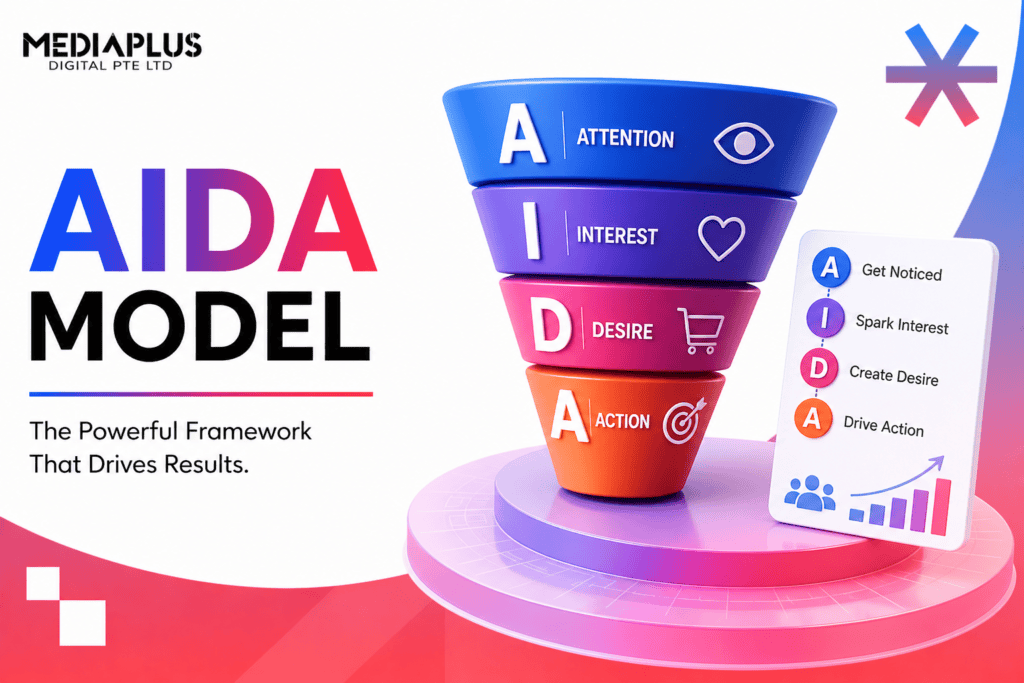
AIDA stands for Attention, Interest, Desire, and Action. It was first articulated by American advertising pioneer Elias St. Elmo Lewis in 1898 to describe the mental journey a buyer takes from first exposure to a brand all the way to purchase. More than 125 years later, the model is still taught in every serious marketing course in Australia, from RMIT to the AANA Marketing Academy, because it works in any medium and any market.
1. Attention: Stop the Scroll
The first job of any marketing message is to pull the audience out of whatever they were doing. In 2026, the average Australian consumer sees more than 6,000 commercial messages a day across feeds, inboxes, billboards, and connected TV. Attention is the scarcest resource in marketing. You earn it with bold visuals, surprising statements, pattern interrupts, and headlines that promise a benefit, a story, or a strong opinion.
2. Interest: Make Them Lean In
Once you have someone’s attention, you have only a few seconds to keep it. Interest is built by talking about a problem the audience already cares about, sharing a useful insight, telling a story they can see themselves in, or quoting a statistic that reframes the conversation. The mistake most Australian businesses make is jumping from attention straight to selling. Interest is the bridge that earns the right to pitch.
3. Desire: Turn Curiosity Into Wanting
Desire is the emotional shift from I like this to I want this. You build desire by translating features into benefits, by showing transformation, and by making the audience picture themselves using your product or service. Social proof, customer stories, before and after results, demos, and well chosen visuals all do the work of moving the prospect from a passive observer to an active buyer in waiting.
4. Action: Make the Next Step Effortless
Action is where most campaigns fail. The audience is ready, but the call to action is vague, the form has too many fields, the page loads too slowly, or the offer lacks a reason to act now. Strong action steps are specific, low friction, and time bound. Book a free strategy call today. Download the 12 page guide. Claim 20 percent off until Sunday. The clearer the next step, the higher the conversion rate.
How to Apply AIDA Across Every Modern Marketing Channel
AIDA is not just a copywriting trick. It is a planning framework for entire campaigns. Here is how the four stages map to the channels Australian businesses use every day.
AIDA on Your Website
- Attention: a clear, benefit driven hero headline above the fold.
- Interest: supporting copy that names the problem and frames the solution.
- Desire: customer logos, testimonials, case studies, and product visuals.
- Action: a single primary call to action repeated throughout the page.
AIDA on Google Search Ads
- Attention: a headline that includes the searcher’s exact query and a strong number.
- Interest: a description that addresses the searcher’s likely intent.
- Desire: extensions that surface reviews, awards, and unique selling points.
- Action: a call to action verb that matches the funnel stage (Buy, Book, Get, Try).
AIDA on Meta and TikTok
- Attention: the first three seconds of video, with bold motion or a question.
- Interest: a problem or insight that resonates with your target audience.
- Desire: proof, demo, or transformation that makes the product feel essential.
- Action: a clear in app CTA, plus a simple landing page that loads fast on mobile.
AIDA in Email Marketing
- Attention: a subject line that promises value and uses curiosity or urgency.
- Interest: an opening sentence that ties to a real reader pain point.
- Desire: a short story, customer win, or persuasive benefit list.
- Action: one clear button, one clear ask, no competing links.
AIDA in SEO Content
- Attention: a title and meta description that match search intent and earn the click.
- Interest: an opening section that confirms the reader is in the right place.
- Desire: depth, examples, statistics, and visuals that build authority.
- Action: an in content CTA to a service page, lead magnet, or contact form.
AIDA in 2026: How AI and Privacy Have Changed the Model
AI has not replaced AIDA. It has supercharged it. Predictive lead scoring now identifies who is likely to engage before a single ad runs, generative tools draft and personalise variations at scale, and analytics platforms measure attention and desire with eye tracking and engagement signals that did not exist five years ago. At the same time, third party cookies are nearly gone, iOS privacy controls have reshaped attribution, and Australian buyers are more sceptical than ever. The brands winning in this environment are not the loudest. They are the ones who use AIDA to earn attention honestly, build interest with substance, create desire through proof, and make action feel safe.
Common Mistakes Australian Marketers Make With AIDA
- Skipping the Interest stage and jumping straight from a hook to a hard sell.
- Confusing features with benefits, which kills Desire.
- Burying the call to action below the fold or hiding it among other links.
- Using a different message at every stage, which breaks the funnel and confuses the buyer.
- Failing to measure each stage, which means you cannot fix the leak when conversions drop.
A Practical AIDA Worksheet for Your Next Campaign
Before you write a single line of copy, answer these four questions in one or two sentences each. Attention: what will make my target audience stop scrolling? Interest: what problem do they have that I am uniquely positioned to solve? Desire: what proof, story, or transformation will make them want what I offer? Action: what is the single, specific next step I want them to take, and how do I make it as easy as possible? Every successful campaign at MediaPlus Digital starts with this exact exercise.
Put AIDA to Work for Your Business in Australia
Understanding AIDA is one thing. Building campaigns that move strangers through every stage is what actually drives revenue. MediaPlus Digital plans, writes, designs, and measures full funnel campaigns for Australian businesses, mapped to AIDA at every step. Explore our digital marketing services for a complete growth engine, accelerate conversions with our PPC management services, capture leads with high performing landing pages, or read our deep dive on the TOF, MOF, BOF marketing funnel to see how AIDA fits inside the wider buyer journey. Want to compare partners first? See the top digital marketing agencies in Australia, or talk to our team for a free AIDA campaign audit.