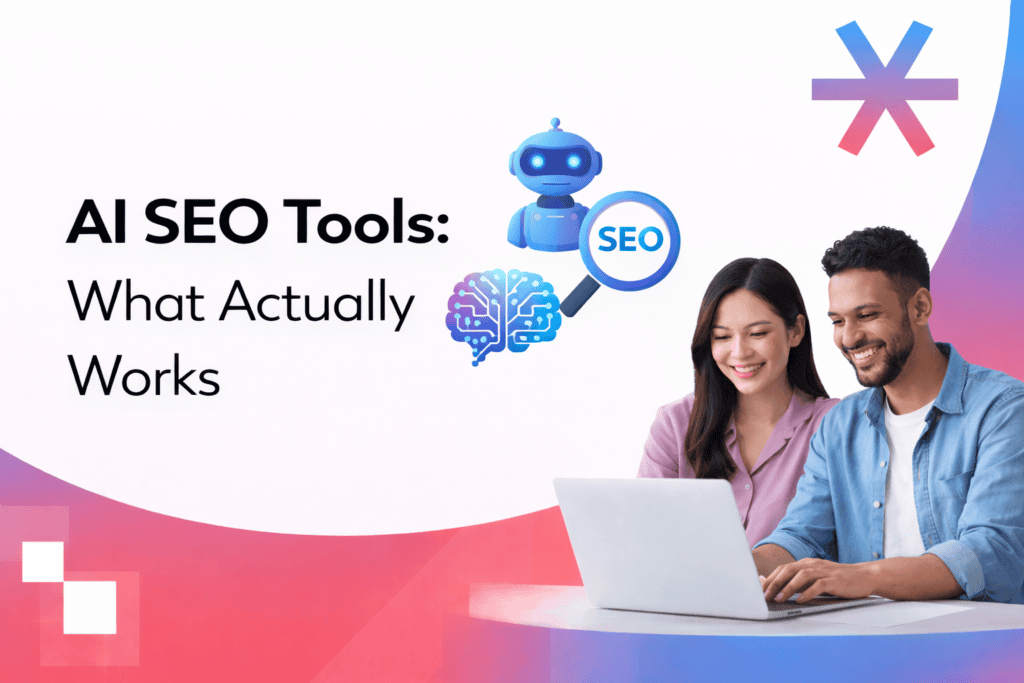
AI SEO tools are everywhere right now. Almost every platform claims it can help you rank faster, write better content, or even “replace SEO work” entirely.
In reality, most tools fall into one of two buckets. They either help you think and execute better, or they generate content that still needs a lot of human fixing. Knowing the difference matters more than the feature list.
After testing and working with many of the most talked-about AI SEO tools, here’s a practical breakdown of which ones actually add value in 2026 and how to use them properly.
What AI SEO Tools Are Really Good At
Before looking at individual tools, it’s worth resetting expectations.
AI SEO tools are strongest at three things: speeding up research, surfacing gaps you might miss, and helping structure content in a way that aligns with search intent. They are far less reliable when used as “push a button and publish” solutions.
The teams getting results use AI as an assistant, not a replacement.
Top AI SEO Tools 2026
Rankability
Rankability is one of the more serious AI SEO tools on the market, especially for agencies and consultants.
What sets Rankability apart is its dual NLP approach, combining IBM Watson and Google Natural Language processing. In practice, this leads to more accurate topic and entity recommendations compared to tools that rely on a single model.
The live content scoring is useful without being overly prescriptive, and the biggest differentiator is the included expert coaching. That turns the tool into part software, part training platform.
It’s not cheap, but if you’re running SEO at scale or managing multiple clients, Rankability earns its place as a core optimization tool rather than a writing gimmick.
Surfer SEO
Surfer SEO is still the most widely adopted content optimization tool, and for good reason.
It’s easy to use, integrates smoothly with Google Docs and WordPress, and gives clear guidance while you write. For teams producing content consistently, Surfer fits neatly into existing workflows.
The downside is that following its recommendations too rigidly can lead to over-optimized content. It works best when treated as a compass, not a checklist.
If usability matters more than deep strategy, Surfer remains a reliable choice.
Clearscope
Clearscope sits firmly in the premium category.
Its keyword recommendations are extremely precise, and the grading system is trusted by large editorial teams. Collaboration features and unlimited users make it attractive for enterprise environments.
However, it is expensive and focused almost entirely on on-page optimization. Solo creators and smaller teams often struggle to justify the cost.
If content quality control and consistency across large teams is your priority, Clearscope still sets the benchmark.
Frase
Frase offers one of the best value-for-money propositions.
It combines SERP research, content briefs, and AI writing in a single platform. For smaller teams and solo creators, this can dramatically reduce research time.
The tradeoff is depth. Keyword suggestions and optimization guidance are lighter compared to higher-end tools, and AI drafts need editing.
Frase works best when speed and affordability matter more than surgical precision.
MarketMuse
MarketMuse is less about individual articles and more about long-term topical authority.
It shines when planning content clusters, identifying gaps across entire sites, and prioritizing what to publish next. For large websites or brands competing in tough niches, this strategic layer is valuable.
The learning curve is steeper, and pricing climbs quickly as you scale. For smaller sites, it can feel like overkill.
MarketMuse is best used by teams thinking in years, not weeks.
Writesonic
Writesonic focuses on speed and accessibility.
It’s easy to onboard, affordable, and capable of producing readable first drafts quickly. For content marketers facing blank pages, that alone can be helpful.
That said, the output often lacks nuance and brand voice. It’s a drafting assistant, not an SEO strategist.
Use it to accelerate production, but never skip editorial review.
AirOps
AirOps targets a different use case entirely.
Instead of optimizing single pieces of content, AirOps is built for automation and scale. Agencies running programmatic SEO or large content operations benefit most from its workflow-based approach.
There is a learning curve, and it’s not beginner-friendly. But for teams managing thousands of pages, it solves problems most tools don’t even address.
How to Choose the Right AI SEO Tool
The mistake most teams make is picking tools based on features instead of workflow.
If you need better briefs and cleaner content, start with Surfer or Clearscope.
If you’re scaling content or building authority across topics, look at MarketMuse or AirOps.
If you want speed without complexity, Frase or Writesonic can help.
No tool replaces strategy. The best results come from combining AI support with strong SEO fundamentals and editorial judgment.
Final Thoughts
AI SEO tools are no longer optional, but they are not magic either.
The teams winning in 2026 are not publishing the most AI-generated content. They are the ones using AI to research smarter, structure content clearly, and adapt to how search behaviour is changing across Google and AI-driven platforms.
Tools alone do not create results. Strategy, experience, and execution still matter. Used correctly, AI SEO tools help strong SEO teams move faster and work more consistently. Used blindly, they simply produce more average content that struggles to stand out.
This is where working with an experienced agency makes a real difference. MediaPlus Digital Australia combines proven SEO Service fundamentals with a forward-looking AI SEO Service approach. Instead of chasing tools or trends, MediaPlus focuses on using AI to strengthen content quality, search intent alignment, and long-term visibility.
Search is no longer just about rankings. It is about relevance wherever users ask questions, whether that happens on Google, AI Overviews, or generative answer engines. Combining the right tools with the right SEO and AI SEO strategy is how brands stay visible in that reality.