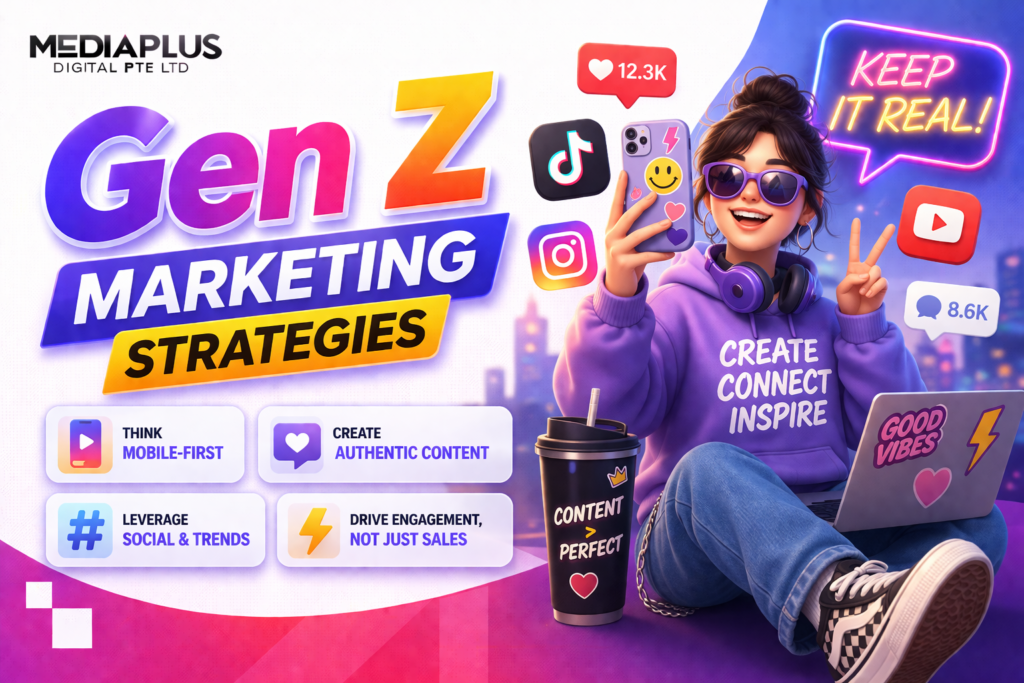
Gen Z is no longer the audience of tomorrow. In Australia they are already about one in five people, they hold real spending power, and they decide what to buy in ways that make traditional advertising look expensive and slow. If your brand still treats Gen Z as a younger version of Millennials, you are leaving money and relevance on the table.
This guide breaks down who Gen Z actually is in the Australian market, the numbers that matter for 2026, the platforms they live on, and eight strategies you can put to work this quarter. It also covers something no overseas playbook will tell you about: the under-16 social media ban that came into effect on 10 December 2025, and exactly how it reshapes who you can reach and how.
Who is Gen Z (and who is Gen Z in Australia)?
Definition box Gen Z are the generation born roughly between 1997 and 2012. In 2026 that makes them about 14 to 29 years old. The older half (roughly 18 to 29) are working, renting, studying and spending. The younger half are still in school, and as of December 2025 many of them are legally off the major social platforms in Australia. That split matters, and we cover it in detail below.
A few things separate Gen Z from every generation before them:
- They are the first true digital natives. Most have never known a world without smartphones and social feeds.
- They research before they buy, and they trust people over brands. A creator with 20,000 followers often carries more weight than a polished TV spot.
- They expect brands to stand for something, and they can spot a hollow gesture instantly.
- They shop, search and get entertained inside the same handful of apps, often without leaving the feed.
Globally, Gen Z is projected to hold around US$12 trillion in spending power by 2030 (global context, not Australia-specific), and the oft-quoted 8-second attention span figure is also a global marketing statistic rather than an Australian one. Treat both as directional context. The Australian numbers below are the ones to plan against.
Gen Z in Australia by the numbers
|
Metric |
Figure |
Source (year) |
|
Share of Australian population |
~18.2% (2021 Census), closer to 20% now, 5M+ people |
ABS Census (2021) |
|
Share of national retail spend |
~5% in 2021, projected to reach ~10% by 2030 |
Telstra (2023) |
|
Online shopping spend, Australian Gen Z |
More than $10 billion in 2023 |
Telstra (2023) |
|
Pay more for brands with positive social impact |
6 in 10 Australian Gen Z |
Yellow (2023) |
|
Discover products via social media |
More than 95% |
Sprout Social (2024) |
|
Own a smartphone |
More than 95% |
Sprout Social (2024) |
|
Preferred platform order (Australia) |
TikTok, then YouTube, then Instagram |
Sprout Social (2024) |
|
TikTok users aged 18+ in Australia |
~8.01 million, ~1.5 hours per day |
TikTok / Oxford Economics (2025) |
|
Value TikTok added to Australian GDP (FY23) |
~1 billion in revenue for Australian businesses |
Oxford Economics (2023) |
The headline: Gen Z’s share of spending is climbing fast, most of their product discovery starts on social, and their attention is concentrated on short-form video platforms. That is the terrain you are competing on.
Why Gen Z marketing matters now
Three reasons this audience deserves budget in 2026, not 2028:
They are entering peak spending years. The older half of Gen Z are earning, moving out and forming brand habits that can last decades. Winning them now is cheaper than winning them later.
They set the trends everyone else follows. Products, sounds, formats and slang move from Gen Z outward. A brand that lands with them often picks up Millennial and Gen X attention for free.
They punish and reward loudly. Gen Z will champion a brand they believe in and drop one they feel misled by, and they will say so publicly. That volatility is a risk, but it is also the fastest word-of-mouth engine available.
If you want the broader mechanics of getting a brand noticed, our guide on how to increase brand awareness pairs well with the tactics here.
The platforms that matter in Australia
Gen Z attention in Australia is not spread evenly. Here is where to focus, in rough order of priority. For a full ranking across all age groups, see our breakdown of the most popular social media platforms in Australia.
TikTok. The centre of gravity for Australian Gen Z. Around 8 million Australians aged 18+ use it, averaging about 1.5 hours a day (Oxford Economics, 2025). It is where trends start, where products go viral and, increasingly, where people search. If you run paid, this is a primary channel. Our TikTok Ads service is built around exactly this audience, and if you would rather compare specialists first, we keep a shortlist of the best TikTok ads agencies in Australia.
YouTube. Consistently the number-one youth brand in YouthInsight surveys, with around 90% of young Australians saying they like or love it. Strong for long-form, tutorials, reviews and Shorts. Note that YouTube is included in the under-16 ban (see below), so plan for a 16+ reach.
Instagram. Still central for fashion, beauty, food and lifestyle, and the natural home for shoppable content. If you sell products, read our Instagram e-commerce strategy guide, and when you are ready to spend, our Instagram Ads service focuses on conversion, not just reach.
Snapchat. Strong for close-friend messaging and younger skews. Useful for AR lenses and location-based offers, less so for broad brand building.
Reddit, Discord and BeReal. Smaller reach but high intent and community depth. Reddit in particular is where Gen Z researches honest opinions before buying, so it is worth monitoring even if you do not post there.
Eight Gen Z marketing strategies (and how to do each in Australia)
1. Lead with authenticity, not polish
Gen Z scrolls past anything that looks like an ad. Phone-shot footage, real staff, real customers and unscripted moments outperform studio gloss. User-generated content (UGC) is the workhorse here.
How to do it in Australia: run a branded hashtag, repost customer clips (with permission), and film in-store or on location rather than in a studio. Our guide to user-generated content covers sourcing, rights and reuse. Use this quick reference:
|
Do |
Don’t |
|
Show real customers and staff on camera |
Use obvious stock footage or actors reading a script |
|
Film vertical, on a phone, in natural light |
Over-produce until it looks like a TV commercial |
|
Reply to comments in a human voice |
Post corporate jargon or copy-paste replies |
|
Admit mistakes and respond openly |
Delete criticism and pretend it never happened |
|
Let creators keep their own style |
Force creators to read your brand script word for word |
|
Back claims with proof (receipts, data, results) |
Make vague ethical claims you cannot evidence |
2. Put short-form video first
Short vertical video is the default format for this audience. Aim to hook in the first two to three seconds and land the point fast.
How to do it in Australia: build a repeatable content engine that ships several TikToks, Reels and Shorts a week. Ride trending sounds and formats while they are hot (most trends last two to four weeks). Batch-film so you are never scrambling for content.
3. Make your values genuine, not a campaign
Six in ten Australian Gen Z say they will pay more for brands with positive social impact (Yellow, 2023). But they can tell the difference between a real commitment and a marketing angle bolted on for a month.
How to do it in Australia: pick causes that connect to your actual business, then show the receipts. If you claim sustainability, publish the supplier, the certification or the numbers. Vague virtue signalling backfires with this group faster than saying nothing.
4. Choose creators over polished ads
A relatable creator beats a glossy brand ad most of the time. Micro and mid-tier creators (roughly 10,000 to 100,000 followers) often deliver better engagement and trust than mega-influencers, and they cost less.
How to do it in Australia: brief loosely. Give creators the message and the boundaries, then let them speak in their own voice. Prioritise Australian creators whose audience matches your customer, and (post-ban) confirm they are 16 or over and posting compliant content.
5. Remove friction from buying
Gen Z expects to discover and buy in the same place. Every extra tap loses sales.
How to do it in Australia: set up TikTok Shop and Instagram Shopping, offer BNPL options this audience already uses (Afterpay, Zip), and make mobile checkout fast. If Instagram is a sales channel for you, our Instagram e-commerce strategy guide walks through the setup.
6. Build community, not just reach
Impressions are a vanity metric with Gen Z. Saves, shares, comments and repeat engagement signal a real connection.
How to do it in Australia: use Instagram Broadcast Channels, reply to every comment for the first hour after posting, and consider a Discord or Reddit presence if your product has a genuine fan base. Optimise for engagement rate, not follower count.
7. Co-create content two ways
Gen Z wants to participate, not just watch. Polls, challenges, duets and stitches turn viewers into contributors.
How to do it in Australia: launch a challenge with a simple, repeatable action and an original sound. Run polls and Q&As in Stories. Invite duets and stitches, then feature the best ones back on your channel.
8. Optimise for social search
Gen Z increasingly searches inside TikTok and YouTube instead of Google. If your content is not written to be found there, it is invisible to them.
How to do it in Australia: write clear, keyword-led captions, add on-screen text, use specific hashtags, and name the product and location plainly (for example “best oat milk flat white Melbourne”). Treat every video as a search result, not just a post.
For paid amplification across all of the above, our Social Media Ads team runs the platform mix end to end, and our performance marketing approach ties it back to revenue rather than reach alone.
The under-16 social media ban: what it changes
This is the single biggest difference between marketing to Gen Z in Australia and anywhere else in the world.
From 10 December 2025, platforms are legally required to remove and block Australian users under 16. The rule covers Facebook, Instagram, TikTok, Snapchat, X, YouTube and Reddit, with penalties of up to AUD $49.5 million for platforms that fail to comply. At rollout, roughly 4.7 million accounts were removed or restricted (eSafety Commissioner; CNBC, 10 December 2025).
What this means for your marketing:
- Your reachable Gen Z audience is now 16 to 29, not 13 to 29. Plan campaigns, tone and offers for that older cohort.
- Reach metrics will look softer as under-16 accounts leave the platforms. Do not read the drop as your content failing; the addressable audience simply shrank.
- Lean on 16+ creators and confirm ages before you sign a partnership. A creator who loses their account mid-campaign is a real risk now.
- Keep content compliant. Platforms are enforcing age rules harder, so avoid anything that could trip age-gating or restrict distribution.
- The under-16 audience has not disappeared, it has moved. They still exist as future customers reached through parents, schools, gaming, in-store experiences and messaging apps outside the ban’s scope. Brand-building with them now still pays off later, just not through the banned platforms.
If your current media plan assumes a 13+ social audience, it needs a rebuild. Our digital marketing service team can rework the channel mix around the new reality.
Australian brands winning with Gen Z
You do not need to guess what works. YouthInsight’s brand tracking shows which names young Australians actually rate:
|
Brand |
Gen Z / youth approval |
Why it lands |
|
Kmart |
83% |
Affordable, meme-friendly, constant TikTok “Kmart hauls” |
|
JB Hi-Fi |
80% |
Tech relevance, straight-talking tone |
|
Chemist Warehouse |
78% |
Value, plus a viral-ready in-store aesthetic |
|
Canva |
70% |
Home-grown Australian tech Gen Z uses daily |
|
Uniqlo |
69% |
Overtook Cotton On in fashion approval |
|
Boost Juice |
69% |
Playful voice, strong app and loyalty game |
|
Cotton On |
68% |
Home-grown fashion with an active social and UGC presence |
Two lessons stand out. First, home-grown names travel well: Canva and Cotton On show that Australian brands can hold their own against global players when they show up authentically. Second, value plus personality wins: the top of this list is affordable brands with a strong, human voice, not premium brands with polished advertising.
Gen Z campaign checklist
Before you launch, run through this:
- Audience defined as 16 to 29 (accounting for the under-16 ban)
- Primary platform chosen (TikTok for most, YouTube or Instagram depending on product)
- Short-form vertical video is the core format
- A content engine is in place to ship several clips a week
- Real people (staff, customers, creators) feature on camera
- UGC sourcing and usage rights sorted
- Creators are 16+, audience-matched and briefed loosely
- Any values or impact claims are backed by evidence
- Buying path is frictionless (in-app shop, mobile checkout, BNPL)
- Captions and on-screen text optimised for social search
- Success measured on engagement and conversion, not raw reach
- Comment moderation and community replies resourced for the first hour after each post
Frequently asked questions
What ages count as Gen Z in Australia?
Gen Z are born roughly between 1997 and 2012, so about 14 to 29 in 2026. For marketing purposes in Australia, your reachable social audience is now 16 to 29 because of the under-16 platform ban.
Which platform should Australian brands prioritise for Gen Z?
TikTok for most, with around 8 million Australian users aged 18+ spending about 1.5 hours a day on it (Oxford Economics, 2025). YouTube and Instagram follow, and the right mix depends on your product. Fashion and beauty lean Instagram; tutorials and reviews lean YouTube.
How does the under-16 social media ban affect my campaigns?
From 10 December 2025, under-16s are removed from major platforms including TikTok, Instagram, YouTube and Snapchat. Your reachable Gen Z audience becomes 16 to 29, reach metrics soften as accounts leave, and you should confirm creators are 16 or over (eSafety Commissioner, 2025).
Do I need a big budget to market to Gen Z?
No. Authentic, phone-shot content and micro-creator partnerships often outperform expensive productions. Gen Z responds to relatability, not budget. A consistent posting habit usually beats one big-budget campaign.
Is influencer marketing still worth it for Gen Z?
Yes, but micro and mid-tier creators (roughly 10,000 to 100,000 followers) usually deliver better trust and engagement than celebrities, and cost less. Brief them loosely so the content sounds like them, not like an ad.
How do I measure Gen Z marketing success?
Prioritise engagement rate, saves, shares and conversions over impressions and follower count. With Gen Z, a smaller, active community is worth more than a large passive one.
What kind of content do Australian Gen Z trust most?
User-generated content, honest reviews and unpolished behind-the-scenes clips. They trust people over brands, so real customers and staff on camera beat scripted advertising almost every time.
Ready to reach Gen Z the right way?
MediaPlus Digital is a Melbourne-based digital agency that builds Gen Z campaigns around the platforms, formats and rules that actually apply in Australia, including the post-ban reality most playbooks ignore. Whether you need a full social media ads programme, a TikTok Ads push, or a performance marketing plan that ties spend to sales, our team can help.
Get in touch with MediaPlus Digital in Melbourne to build a Gen Z strategy that reaches the right audience and turns attention into revenue.