
Quick answer: A Google Ads strategy is the set of decisions you make before spending anything: which campaign types to run, how to structure them, which keywords and match types to use, how to bid, where the traffic lands, and what counts as success. Most accounts fail on structure and destination rather than on bidding.
Most Google Ads accounts do not have a strategy. They have a budget and a list of keywords.
The difference matters, because the decisions that determine whether an account works are almost all made before launch. Once the campaign is live, you are optimising within the structure you chose, and a poor structure cannot be optimised into a good one.
This guide covers the ten decisions, in the order you should make them. It is about planning rather than day to day management. If you want the ongoing task list, our Google Ads optimisation checklist covers that separately, and types of Google Ads covers the campaign formats in detail.
1. Decide what a conversion actually is
Before anything else, define the outcome. Not “traffic”. Not “brand awareness”. The specific action worth money.
For most Australian businesses that is a phone call, a form submission, a booking or a purchase. Set it up as a conversion in Google Ads, and if calls matter, use call tracking so calls from ads are attributed properly.
Everything downstream depends on this. Smart bidding cannot optimise toward a goal you have not defined, and you cannot judge the account without it. Accounts running without conversion tracking are guessing, and usually spending more than they need to.
Know two numbers before you start:
- Average value of a converted customer
- What share of enquiries become customers
Those two set the maximum you can afford to pay per enquiry.
2. Choose which campaign types to run
Not all at once. Each does a different job.
|
Campaign type |
Intent captured |
Best for |
|
Search |
High, actively looking |
Almost everyone. Start here |
|
Performance Max |
Mixed, automated across networks |
Ecommerce, established accounts with data |
|
Shopping |
High, product specific |
Retail with a product feed |
|
Display |
Low, browsing |
Retargeting, not cold prospecting |
|
YouTube |
Low to medium |
Awareness, considered purchases |
|
Demand Gen |
Low to medium |
Visual products, discovery |
Start with Search. It captures people already looking for what you sell, which means the shortest path to a return. Add others once Search is profitable and you have conversion data to feed them.
A note on Performance Max. It works well with enough conversion data and a clear feed, and poorly on small budgets with thin data, where it becomes a black box spending money on branded terms you would have won anyway. For a new account, prove Search first.
3. Structure campaigns by intent, not by product list
The default approach is one campaign with everything in it. That gives you no control over budget or bidding.
Structure by intent instead, so you can fund the profitable segments separately:
- Brand campaign. Your own business name. Cheap, high converting, and it stops competitors taking your traffic
- High intent generic. “commercial electrician melbourne”, “emergency plumber brisbane”
- Research intent. “how much does a website cost”. Lower conversion, cheaper clicks, longer payback
- Competitor terms. Optional, expensive, sometimes worth it
- Retargeting. Cheapest conversions in the account
Then split ad groups by service, so each group has its own ads and its own destination. If an ad group contains twelve unrelated keywords, no ad can be relevant to all of them, and Quality Score falls.
4. Build the keyword list around intent, not volume
High volume terms are usually the least profitable. “Web design” is broad and mostly researchers. “Web design agency melbourne” is fewer searches and far more buyers.
Favour longer, more specific terms with clear commercial intent. Include location where the service is local.
On match types. Start with phrase and exact. Broad match on a small budget without solid negatives will consume it. Once you know what converts, test broad match with smart bidding and a strong negative list.
5. Build the negative keyword list before launch
This is where most Australian ad budgets leak, and it is preventable.
Add these before the first click:
Employment: jobs, careers, hiring, salary, wage, apprentice, resume, seek, indeed Learning: course, courses, training, tafe, certificate, tutorial, how to, diy Free and cheap: free, cheapest, template, torrent Wrong intent: wikipedia, definition, meaning, reddit, examples Irrelevant geography: any country or city you do not serve
Then run the search terms report fortnightly and keep adding. Thirty or more negatives in the first month is normal on a new account.
6. Get the location settings right
Two settings cost Australian advertisers more than any others.
Target by suburb, postcode or region, not by a radius around a capital city. A 30km radius from Melbourne CBD includes areas you will not service.
Change location options to “Presence”, meaning people in or regularly in your targeted locations. Google’s default is “Presence or interest”, which shows your ads to someone in Perth researching Melbourne suppliers. This single setting routinely removes a meaningful share of wasted spend.
Use ad scheduling if you only answer during business hours. Paying for a click that rings out is the worst outcome available.
7. Choose a bidding strategy that matches your data
|
Situation |
Strategy |
|
New account, no conversion data |
Manual CPC or Maximise Clicks, briefly |
|
15+ conversions per month |
Maximise Conversions |
|
Conversion values vary |
Maximise Conversion Value or Target ROAS |
|
Stable account, known cost per acquisition |
Target CPA |
The common mistake is switching to a smart bidding strategy before the account has enough conversions to learn from. Below roughly fifteen conversions a month, automated bidding has too little signal.
Give any strategy change two to three weeks before judging it. Changing bids daily prevents the system from learning.
8. Decide where the traffic lands
The most under-considered decision in most accounts, and often the largest lever.
Sending all ad traffic to the homepage suppresses conversion rate and Quality Score at the same time, which means you pay more per click and convert fewer of them.
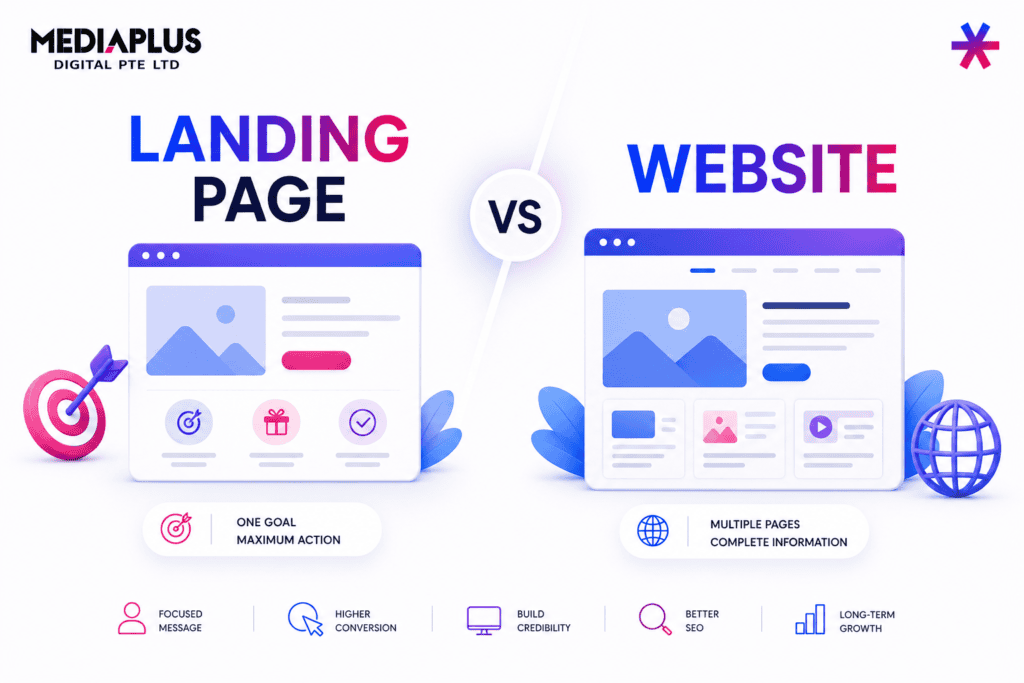
Each ad group should point at a page about that specific thing, with the headline matching the ad, one clear action and a short form. Our comparison of landing pages and websites covers when a dedicated page is worth building, and landing page development covers having them built.
Doubling conversion rate halves your cost per enquiry without touching a bid.
9. Set the budget from the maths, not the gut
Work backwards from the outcome you want:
- How many new customers a month? Say 10
- What is your close rate on enquiries? Say 40%, so 25 enquiries needed
- What does the landing page convert at? Say 8%, so about 310 clicks
- What is your cost per click? Say $6, so roughly $1,900 a month
Then check the answer against value. If a customer is worth $2,000, spending $190 to get one is comfortable. If a customer is worth $250, the maths does not work and you need cheaper clicks, better conversion or a different channel.
A practical floor: below about $1,000 a month, competitive Australian categories struggle to gather enough data to optimise. Below that, put the money into your Google Business Profile and organic search instead.
10. Decide how you will judge it, and when
Set the review cadence before launch so decisions are not made emotionally in week one.
- Weekly: search terms report, negatives, obvious waste
- Fortnightly: ad performance, landing page conversion rate
- Monthly: cost per conversion by campaign, budget reallocation
- Quarterly: strategy, structure, whether the channel is earning its place
Track cost per acquired customer, not cost per click. A campaign with expensive clicks and a high close rate beats a cheap campaign that produces enquiries who never buy.
Allow six to eight weeks before judging a new account. The first fortnight is data gathering and will look worse than the eventual position.
The five mistakes that waste the most
- No conversion tracking. Optimising blind
- Location options left on the default. Paying to reach the wrong state
- All traffic to the homepage. Halves conversion rate for no reason
- Ignoring the search terms report. The gap between the keywords you bid on and the searches you pay for is where budget disappears
- Pausing when busy. Rebuilding performance after a stop costs more than running a reduced budget through quiet periods
Frequently asked questions
What is a Google Ads strategy?
The decisions made before launch: campaign types, structure, keywords and match types, negatives, location settings, bidding, landing pages, budget and how success is measured.
How much should I spend on Google Ads in Australia?
Work backwards from customers needed, close rate, landing page conversion rate and cost per click. A practical floor for competitive categories is around $1,000 a month.
Should I use Performance Max?
Once Search is profitable and you have consistent conversion data. On a new, small account it tends to obscure where money is going.
How long before Google Ads works?
First enquiries can arrive within days. Allow six to eight weeks for the account to stabilise and the data to be worth acting on.
Is Google Ads better than SEO?
They do different jobs. Ads produce enquiries immediately and let you test which services and locations convert. SEO takes months then delivers without a cost per click. Use the ad data to decide which SEO pages to build. Our comparison of SEO and PPC covers the trade off.
Can I manage Google Ads myself?
The interface is accessible. The parts requiring experience are negative keyword discipline, structure, and knowing whether a poor result is an account problem or a landing page problem.
Where to start
Before adjusting a single bid, do these three things: confirm conversion tracking is working, change location options to “Presence”, and build one landing page for your highest spend service. Those three typically improve cost per enquiry more than any bidding change.
Our Google Ads and PPC teams manage accounts for Australian businesses. Get in touch for an account review and we will show you where the spend is leaking.