AI chatbots have evolved from clunky FAQ machines to sophisticated conversational agents that can qualify leads, book appointments, handle customer support, and even process orders. For Australian businesses, they offer a way to provide 24/7 service without 24/7 staffing costs.
This guide covers what AI chatbots are, how to implement them, which platforms to use, and how to avoid the common mistakes that make customers hate chatbots.
What Are AI Chatbots?
AI chatbots are software programs that use artificial intelligence – typically natural language processing (NLP) and machine learning – to understand and respond to human messages in real time. Unlike rule-based chatbots that follow scripted decision trees, AI chatbots can understand intent, handle unexpected questions, and improve over time.
Types of Chatbots
|
Type |
How It Works |
Best For |
Limitation |
|
Rule-Based |
Follows pre-written scripts and decision trees |
Simple FAQs, basic routing |
Can’t handle unexpected questions |
|
AI-Powered |
Uses NLP/ML to understand intent and generate responses |
Complex support, lead qualification |
Requires training data, higher cost |
|
Hybrid |
AI handles initial interaction, escalates to human when needed |
Most business use cases |
Needs clear escalation rules |
Benefits of AI Chatbots for Business
- 24/7 availability – Chatbots never sleep, take breaks, or call in sick. For Australian businesses serving customers across time zones, this is especially valuable.
- Cost reduction – Chatbots can handle 80% of routine customer queries, freeing human agents for complex issues. Businesses report 30-50% reduction in support costs.
- Faster response times – 90% of customers rate an “immediate” response as important. Chatbots respond instantly, eliminating wait times.
- Lead qualification – Chatbots can ask qualifying questions, collect contact details, and route hot leads to sales teams – automatically and at scale.
- Data collection – Every conversation generates data about customer questions, pain points, and preferences – invaluable for improving products and marketing.
Implementation Steps
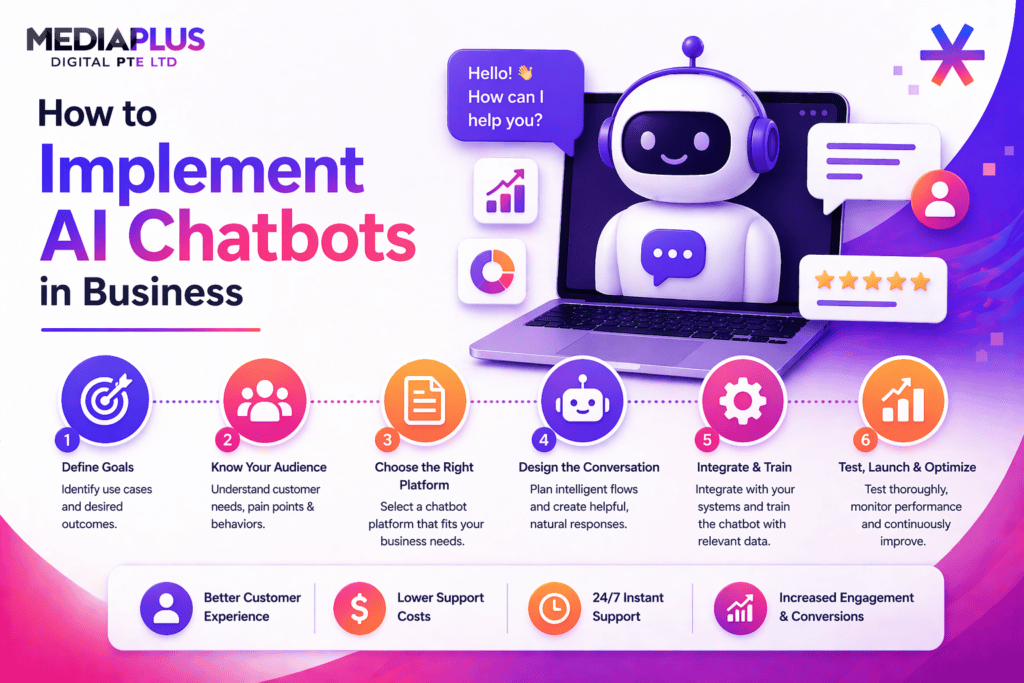
Step 1: Define Clear Goals
What do you want the chatbot to achieve? Common goals: reduce support ticket volume by X%, qualify Y leads per month, provide instant answers to top 20 FAQs, book appointments automatically, or recover abandoned carts. Start with one or two goals, not everything at once.
Step 2: Choose the Right Platform
|
Platform |
Best For |
Starting Price |
|
Intercom |
SaaS and tech companies |
From $39/month |
|
Tidio |
Small businesses and ecommerce |
Free tier available |
|
Drift |
B2B lead generation |
Custom pricing |
|
ManyChat |
Social media (Instagram, Facebook, WhatsApp) |
Free tier available |
|
Dialogflow (Google) |
Custom AI chatbot development |
Pay-per-use |
|
ChatGPT API (OpenAI) |
Custom conversational AI |
Pay-per-token |
|
Zendesk AI |
Customer support teams |
From $55/agent/month |
Step 3: Design Conversation Flows
Map out the most common customer journeys and design conversation flows for each. Start with a greeting, identify intent (what does the user need?), provide the answer or action, and offer escalation to a human agent. Keep responses concise – chatbot messages should be shorter than human messages.
Step 4: Integrate With Your Existing Tools
Connect your chatbot to your CRM (HubSpot, Salesforce), helpdesk (Zendesk, Freshdesk), calendar (Calendly, Google Calendar), ecommerce platform (Shopify, WooCommerce), and email marketing tool (Klaviyo, Mailchimp). Integration is where chatbots become truly powerful – they don’t just answer questions, they take action.
Step 5: Train, Test, and Launch
Train the chatbot on your most common questions and scenarios. Test extensively – with your team, beta customers, and edge cases. Launch to a small segment first (e.g., one page of your website) before rolling out site-wide. Monitor conversations in the first weeks and refine responses based on real interactions.
Step 6: Monitor and Optimise
Track key metrics: containment rate (% of conversations resolved without human help), customer satisfaction (CSAT) score, average response time, conversion rate (for lead gen chatbots), and escalation rate. Continuously review conversation logs to identify gaps and improve responses.
Common Use Cases
- Customer support – Answer FAQs, track orders, handle returns, troubleshoot common issues.
- Lead qualification – Ask qualifying questions, capture contact details, book demos or consultations.
- Appointment booking – Integrate with calendar tools to let customers book meetings directly in chat.
- eCommerce assistance – Product recommendations, size guides, stock checks, and cart recovery.
- Internal operations – HR chatbots for employee FAQs, IT support bots, onboarding assistants.
Common Mistakes to Avoid
- Pretending the chatbot is human – always disclose that users are talking to a bot. Deception destroys trust.
- No escalation path to a human agent – chatbots should know their limits and hand off gracefully.
- Too many questions before providing value – get to the answer quickly, don’t interrogate users.
- Ignoring conversation data – the questions your chatbot can’t answer are your biggest improvement opportunities.
- Launching without testing – test every scenario, including edge cases and frustrated users.
- One-size-fits-all responses – personalise responses based on context (returning customer vs new visitor, page they’re on).
Measuring Chatbot ROI
- Support cost reduction – Calculate: (tickets handled by chatbot x average cost per ticket) = savings.
- Lead generation value – Calculate: (leads generated by chatbot x lead-to-customer conversion rate x average customer value).
- Time savings – Hours saved by support team x average hourly cost.
- Customer satisfaction – Compare CSAT scores before and after chatbot implementation.
Final Thoughts
AI chatbots are no longer a novelty – they’re a business tool that, when implemented correctly, reduces costs, improves customer experience, and generates leads around the clock. The key is starting simple, measuring results, and iterating based on real conversation data.
Want to integrate AI chatbots into your digital strategy? Get in touch with MediaPlus Digital Australia for a free consultation.